Tuesday, February 8, 2011

Hell's bells

(Note: all photos in this post were taken by me when I visited the Kremlin in July 2010. Click to see larger versions.)

Taking a break from researching/writing a speech about the American justice system for the Yale Political Union's Gardner-White Prize Debate on R: Bring back the stocks tonight. In between skimming Gresham Sykes's The Society of Captives and wading through the Bureau of Justice Statistics's Survey of Sexual Violence, I've been going through my music library looking for songs about prisons, criminals, gangs, etc. Of course ended up listening to one of my top five Tom Waits songs, "Hoist that Rag", and a certain line caught my attention in a new way:

(I can never resist posting live performances, but you can hear the studio version, which is brilliant and perhaps more palatable to less seasoned Waits fans, here.)
"Well, we stick our fingers in the ground,
heave and turn the world around.
Smoke is blacking out the sun,
at night I pray and clean my gun.
The cracked bell rings as the ghost bird sings;
the gods go begging here.
So just open fire when you hit the shore,
all is fair in love and war."
I've listened to this song probably at least a hundred times, but this time the image of the cracked bell caught me and reminded me of Leonard Cohen's "Anthem" (which I heard for the first time a few weeks ago, courtesy of the Ochlophobist):

"So, ring the bells that still can ring,
forget your perfect offering.
There is a crack in everything,
that's how the light gets in."
New Haven, where I've lived for nigh four years now, is full of the noise of bells, from the widely hated carillon in Harkness Tower to the more modest Christ Church bells, rung before Compline on Sundays. Bells have in their call an unnerving mix of the joyful and the ominous, every peal containing within it the calm foreboding of Gust Avrakotos's Zen master in Charlie Wilson's War: we'll see, we'll see, we'll see, yes, yes, we will see.
"The weak sounds of wood and metal remind us of the unclear, mysterious words of the prophets, but the loud and vigorous play of bells is like the rejoicing of the Gospel, radiating out to all corners of the universe and lifting one's thoughts to the angelic trumpets of the last day."
(note: don't have access to the book I got this from at the moment, will cite source later)
"The bell played an important part in material as well as spiritual culture through its technological tie-in with the manufacture of cannon. Already by the late fourteenth century--only a few years after the first appearance of cannon in the West--Russians had begun to manufacture cannon along with bells; and, by the sixteenth century, they had produced the largest of each item to be found anywhere in the world...
They represent the first example of 'overtaking and surpassing' a superior technology. But they illustrate as well the artificiality of of the accomplishment. For the bell was too large to hang, the cannon too broad to fire."
- James Billington, I&A
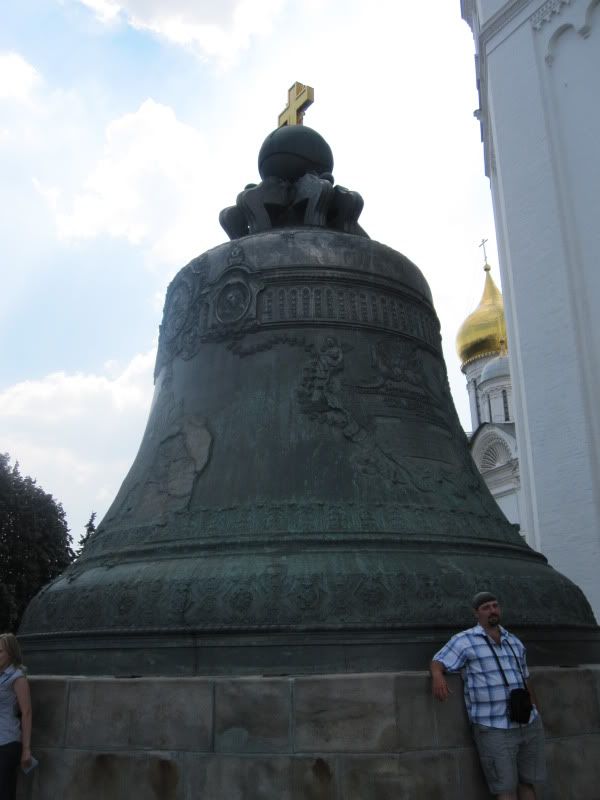
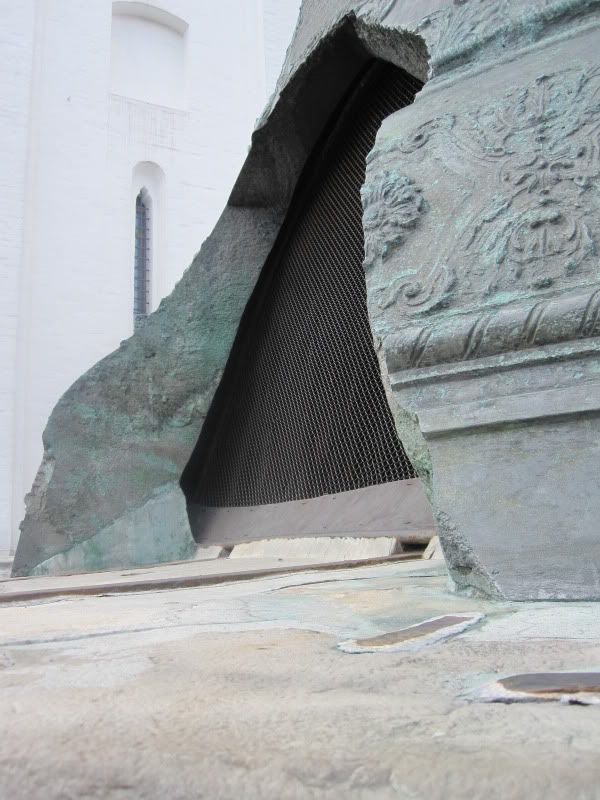
Not only was the Tsar'-kolokol (Tsar-bell), as it was called, too large to hang, but it in fact cracked while it was still being cast. During a massive fire in 1737, cool water was thrown onto the bell while in the casting pit to prevent it from melting-- the sudden temperature change left us with the bell you see below.
So then: cracked bells, how do they work (as symbols fraught with theological, historical, and literary significance approaching the self-indulgently gravid in these three distinct, unrelated, and arbitrarily selected contexts)?

First we have this Waitsian image signalling perversion of the natural order, both summoning us to, and heralding our arrival at, the Absurd, the Surreal-- "The Lowside of the Road", as Tom himself might put it (which, incidentally, is also the title Barney Hoskyns chose for his unauthorized TW biography). "Lowside" was released on 1999's Mule Variations, five years before Real Gone and "Hoist that Rag". Think of the darkest, most inscrutable moments in O Brother, Where Art Thou? "Lowside" not only describes that world, but makes us realize we've been there too, and might be there still.
"The moon is red and you're dancin' real slow,
twenty-nine miles left to go.
The chain monkeys help you with your load,
you're rollin over to the lowside of the road."

...

Well the clapper has been ripped out of the bell,
The flapper has been kicked right out of hell.
When the horse whips the man that he rode,
you're rollin over to the lowside of the road."
Again: soundless bells announcing the unexpected, the contrary, the impossible: "the gods go begging here," "the flapper has been kicked right out of hell".

Cohen, despite imploring us to acknowledge our inescapable imperfection, seems to present a much brighter vision, one that echoes in its simplicity and joy the bells of early Rus', or perhaps the end of Gogol's Dead Souls: "Where art thou soaring away to, Russia? Give me the answer! But Russia gives none, save the bell pouring forth marvelous sound..."

But here I think the reality of the Tsar-bell links Cohen and Waits: intended to signal to the world the strength, expertise, and piety of "the New Jerusalem", it was undone by nothing grander than one of the basic elements. It stands both as an impressive monument and a humbling castigation-- it is an absurdity, a paradox, a thing both of beauty and of shame. Like the maimed bells of "Lowside" and "Hoist that Rag", it reminds us that we are in a world beyond our comprehension, and like the one beginning Cohen's "Anthem", it assures us that our feckless, discordant acts of worship are loved nevertheless.

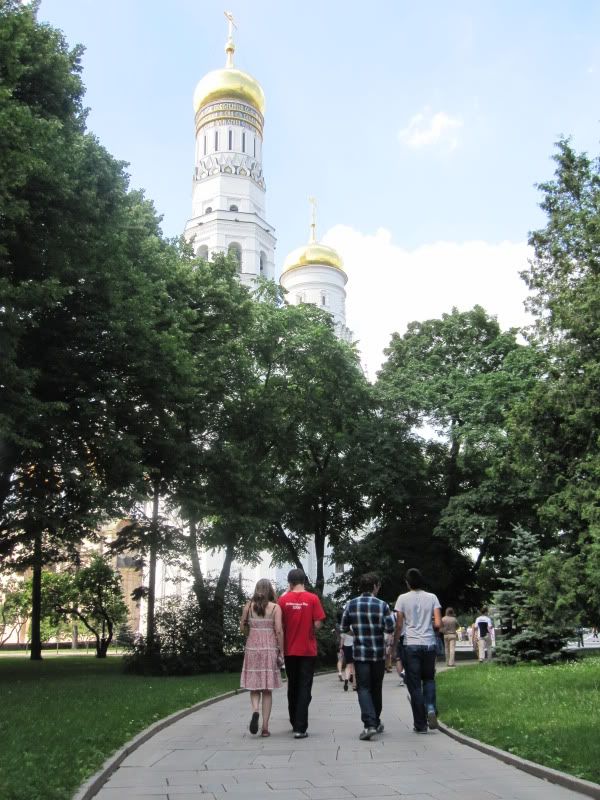
Photo 1: Колокольня Ивана Великого/Ivan the Great Bell Tower
Photo 2: Царь-колокол/Tsar-bell
Photo 3: The giant crack in the Tsar-bell

Sunday, February 6, 2011

"Iconic" Fashion

Not quite what Turgenev had in mind when he wrote "Living Relic", but these runway shots from Jean Paul Gaultier's Spring '07 collection remind me of something burst from an Icon (is that heretical? God save me).


Apologies for the hiatus; the winter holidays were followed closely by a death and a third bout of quinsy for me, but will hopefully be writing more soon. February should provide me with more than enough blog fodder, between CPAC next week and surgery the week after. My doctor tells me I won't want to so much as think about smoking or drinking the first 10 days afterward, and even if I do it'll cause all manner of complications if I don't give my throat a good three weeks to heal. Expect a lot of very, very frustrated writing (or repeated hospital visits, if my sense of immortality gets the better of me). Ora pro me.

Tuesday, December 21, 2010

A tobacco roundup

CIVILIZATION REQUIRES ASHTRAYS
Smoking bans lead to more indoor fires!

AND YOU THOUGHT JIM MORRISON WAS A REBEL
Alt-rock band/mellifluous troupe of conspiracy theorists Muse was very nearly banned from performing anywhere in Australia for smoking during a show last week.

I'M ONLY GONNA BREAK, BREAK YOUR PSEUDO-SCIENTIFIC ANTI-SMOKING CONCEIT
"In contrast with smaller regional studies we find that smoking bans are not associated with statistically significant short-term declines in mortality or hospital admissions for myocardial infarction or other diseases. ... An analysis simulating smaller studies using subsamples reveals that large short-term increases in myocardial infarction incidence following a smoking ban are as common as the large decreases reported in the published literature," (emphasis mine).
More here and here.

NOW THIS IS THE KIND OF ADVERTISING I OBJECT TO
I Love You, Phillip Morris is in no way about cigarettes.

THIS IS A PRO-SMOKING CIGARETTE SONG/
SO EVERYBODY LIGHT ONE UP AND FUCKING SING ALONG
"More intelligent American children are more likely to grow up to consume more tobacco, while more intelligent British children are more likely to grow up to consume more illegal drugs." This is because Americans are inherently superior.

SECONDHAND SMOKE AND MIRRORS
A one-time niconazi is converted! Also, John Banzhaf continues to be the worst person in the world.

YOU MANIACS, YOU BLEW IT UP! AH, DAMN YOU! GOD DAMN YOU ALL TO HELL!
What has become of NYC that police officers can not only mistake a man smoking outside a window for a potential jumper, but bring him in for a psych eval against his will? Have New Yorkers already forgotten what cigarettes look like?

A SONG
"Ashtray Heart" - Captain Beefheart (RIP)

"You used me like an ashtray heart
You picked me out, brushed me off
Crushed me while I was burning out
Then you picked me out
Like an ashtray heart"


Monday, December 20, 2010

The way to an atheist's soul is through her stomach?

Decorated cookies with Leah of Unequally Yoked yesterday. Don't think we made any breakthroughs regarding her crypto-gnosticism or apparent fondness for Jane Austen, but I did get some sweet cookies out of the deal.
Had a lot of fun being the sole conservative at this get-together. Left to right: paying homage to the 'Pythagorean Brotherhood', an apparently rabies-infected GO-pachyderm (couldn't resist, sorry), and John Galt's pig.
Vaguely Soviet looking star, a snowman-shaped cookie reimagined as a cannon, Russian patriotism as baked good, and a Cairn terrier.

(Yes, Russian patriotism as baked good is probably stuffed with mushrooms and looks like this, but cut me some slack.)

Merry Christmas!

Vaguely related: here is a lovely story about Saint Silouan and atheists (start at "After his experience of the tortures of hell...").

Friday, December 17, 2010

"I will not cease from honoring that matter which works my salvation."

“Our teacher simply commanded: 'Stand up!' and we put our pointe shoes on our bare feet and started the class. At the end of the lesson the slippers were covered in blood. I don’t consider them to be relics, but I could never throw those pointes away. They are a very touching reminder of childhood — like my first essays and my first math exercise books, which are covered in scribbles.”
- Yekaterina Kondaurova, Mariinsky ballet soloist

I was going to try to turn this into an extended post about "memorialism", pneumatic presence, gnosticism, veneration of relics, Christian attitudes toward burial, and ultimately the centrality of contingency and immanence/beauty (together with, if not outright contra in some cases, transcendence/sublimity), but really, I think (as I so often do) that David Hart says it best: "surfaces are always more complicated than 'depths'."

(If, however, anyone is somehow interested in me spouting off on those topics, do let me know.)

Tuesday, December 14, 2010

The Sieve: The Third Policeman

The following is an excerpt from Flann O'Brien's The Third Policeman, a "brilliant comic novel about the nature of time, death, and existence," which I happen to be enjoying rather perversely on this bitterly cold day. The italics indicate what the narrator has dubbed his soul (whom he has named Joe) speaking to him.
"I smiled at him in good-humoured perplexity and said:

'Tricky looking man, you are hard to place and it is not easy to guess your station. You seem very contented in one way but then again you do not seem to be satisfied. What is your objection to life?'

He blew little bags of smoke at me and looked at me closely from behind the bushels of hair which were growing about his eyes.

'Is it life?' he answered. 'I would rather be without it,' he said, 'for there is a queer small utility in it. You cannot eat it or drink it or smoke it in your pipe, it does not keep the rain out and it is a poor armful in the dark if you strip it and take it to bed with you after a night of porter when you are shivering with the red passion. It is a great mistake and a thing better done without, like bed-jars and foreign bacon.'

'That is a nice way to be talking on a grand lively day,' I chided, 'when the sun is roaring in the sky and sending great tidings into our weary bones.'

'Or like feather-beds,' he continued, 'or bread manufactured with powerful steam machinery. Is it life you say? Life?'

Explain the difficulty of life yet stressing its essential sweetness and desirability.

What sweetness?

Flowers in the spring, the glory and fulfillment of human life, bird-song at evening--you know very well what I mean.

I am not so sure about the sweetness all the same.

'It is hard to get the right shape of it,' I said to the tricky man, 'or to define life at all but if you identify life with enjoyment I am told that there is a better brand of it in the cities than in the country parts and there is said to be a very superior brand of it to be had in certain parts of France. Did you ever notice that cats have a lot of it in them when they are quite juveniles?'"

Thursday, December 9, 2010

"It won't be my fault if I die an Old Maid"

My mother pretends for a wife I'm too young,
and says that men will deceive me.
But let her look back, she'll soon hold her tongue;
if not, 'tis no matter, believe me.
Sweet gentlemen, don't be a moment in fear,
and suffer a damsel to keep singing here,
remember a thought to no girl is so dread,
as the terrible one--that she may die an old maid.

Mother preaches forever against men, the vile sex,
and says every look is alarming,
but, between you and I, this she says only to vex,
for I know that she thinks you all charming.
Three husbands she has had in the course of her life,
now I only want one, sir, "Pray who'll have a good wife?"
Now men don't be stupid and look half-afraid!
Speak boldly, or else I must die an old maid.

Men boast they are kind, and easily had,
and lovers are willing and plenty,
I vow it is false, for I've not got a lad,
although I'm turned one-and-twenty.
The man I love best now stands in full view--
don't look so sharp, sir! I did not mean you,
but that handsome man there--O, what have I said,
but it won't be my fault if I die an old maid.

- The Quaver; or, Songster's Pocket Companion:
containing upwards of One Thousand of the most popular Songs, Toasts, Sentiments, and Recitations