Showing posts with label It's not ethnic chauvinism if it's true. Show all posts

Sunday, July 1, 2012

[TSE] Holiness or Heresy: Evolving Models of Iurodstvo in Medieval Russia

Notes for the Reader
Excerpts will be posted unedited; will post my own commentary at the end. All senior essay related posts will be tagged "Batiushka Ioann". Footnotes will appear at the bottom of each excerpt. Prologue here.
Questions, critiques, and reactions of any kind warmly encouraged; I am looking to strengthen and improve. Please remember that this is essentially a hastily written draft.
Writing about theology and Church history as an inexperienced believer for a secular academic audience is harrowing. Don't ignore weaknesses and errors, particularly if they could be interpreted as heretical or blasphemous, but be cognizant of my constraints.

II. Holiness or Heresy: Evolving Models of Iurodstvo in Medieval Russia

The tradition of holy foolishness, a particularly enigmatic genre of sanctity, originates in the Gospel itself; Paul of Tarsus mentions a connection between foolishness and the Divine several times in his First Letter to the Corinthians, but of particular relevance is this passage: “Let no man deceive himself. If any man among you seemeth to be wise in this world, let him become a fool, that he may be wise. For the wisdom of this world is foolishness with God. For it is written, He taketh the wise in their own craftiness.”7 The lived tradition of foolishness-for-Christ began in Byzantium, but it was in medieval Muscovy that the practice became most well-known. The Russian holy fool (iurodivyi) soon took on a particular role: he was not merely a man conquering pride through madness and humiliation, but “a form of divine control over the state authorities.”8 This other-worldly rebuke of secular power is famously illustrated in the confrontation between Nicholas of Pskov and Tsar Ivan IV, in which the fool sends the Tsar a piece of bloody meat to chastise him for his massacres. Importantly (in legend, if not in historical fact), Ivan repents, and orders the city spared.

By the seventeenth-century, however, the protective aura of dread and wonder that had largely shielded the iurodivye from institutional persecution had begun to dissipate. Patriarch Iosif in 1646 barred them from entering churches, “since their shouting and squealing prevents Orthodox Christians from hearing the divine chanting, and they come into God’s churches like robbers, carrying sticks…”9  Instructive is the story of another Sergiev, called Ioann the Big-Cap of Moscow, whose life provides an example of the interplay between temporal authority and manifestation of holiness.

He was born around 1670 into a peasant family and spent most of his life wandering from monastery to monastery. Unlike many holy fools, it seems that he wanted to become a monk. Because of Peter I’s ecclesiastical reforms, Ioann, as an illiterate peasant, was prohibited from being tonsured—unless he could convince the highest court to grant an exception and obtain a Synodal dispensation. As Aleksandr Lavrov notes, “one may well wonder how an illiterate could ever have obtained the latter. For most people, therefore, the path to monastic asceticism was simply closed. For this reason, in examining religious recluses…we must consider as motives not only a certain sense of footloose self-determination but also the pressure exerted by the dominant religious culture that forced them to adopt alternative ways.”10  Unlike his forbears in iurodstvo, Ioann rarely ran afoul of authority, and was generally accepting of whatever treatment he was given: after the signing into law of a new regulation demanding that “there be no truck with anchorites and sanctimonious men with matted locks,” the Bishop of Vologda ordered him shorn, a castigation to which he meekly submitted.11 Nor could he be accused of heresy or schismatic sympathies: he regularly confessed and took Communion, and in spite of the tumultuous Sobor of 1666-7 in which the Old Believers were anathematized, he swore that he “recognized no schism” and “crossed himself with three fingers and not with two.”12 It seems that he was marked as a holy fool only by his heavy chains, iron cap, and aimless wanderings. All this notwithstanding he was captured in 1733 and “returned to his place of registration.”13

What happened in the 150 years separating Nicholas and Ioann? Despite late Muscovy’s low literacy rate (Gary Marker, estimating generously, pegs it below ten percent), highly public liturgical services combined with mass migration spurred by the Time of Troubles to disseminate tales of iurodstvo throughout and across cities and villages.14 As popular veneration grew, the Church became increasingly wary, striking names from prayer-books and speaking out publicly against the visible and behavioral markers characteristic of the iurodivye.15 Their renown was beginning to spread beyond her reach, and not in ways she welcomed. In Holy Fools in Byzantium and Beyond, Sergey Ivanov quotes the testimony of many foreign travelers to Russia who were surprised by the free reign given the iurodivye; some, like Isaac Massa, openly pitied the Russians for their gullibility: “…if I was the tsar I would order the last rite for her before it was my turn; but these Muscovites consider her holy; which is not surprising, since—alas—they are still mired in ignorance. May God enlighten them!”16

More serious are scenes from the iurodivye vitae in which they commit unpredictable acts of violence, such as Prokopii of Viatka killing an infant “to resurrect it later” and holding a knife to his confessor’s throat, or Simon of Iurevets strangling a priest with his bare hands.17 While in some sense these stories warn the faithful of the fundamental incomprehensibility of the fool’s actions, in another they are deeply subversive: “regardless of how the hagiographer tries to explain it—aggression against the priest is semantically significant as a sign of rebellion against the Church.”18

Here we see the tension between hagiography and mere narrative. The earliest holy fools were relatively isolated examples of eccentric holiness, fantastic aberrations that inspired awe and served as a kind of memento mirari, but as stories of their exploits were collected into vitae and became reified into a particular model for communing with the Divine, they took on the normativity of other saints’ lives, opening the door for ever increasing numbers of feral, bullheaded vagrants to roam the kingdom. Ivanov notes that “the emergence of at least one local iurodivyi almost inevitably called forth a wave of imitators.”19

While the prelates struggled to manage the destabilizing effects of popular iurodstvo, the iurodivye themselves were transforming. The first iurodivaya (female holy fool) appeared during the reign of Boris Godunov (1585-1598); like Nicholas of Pskov, she was wholly unafraid of anyone, including the tsar, and would often foretell future events.20 Despite the similarities, the modern observer must understand the strangeness of an isolated sixteenth-century woman taking on what had been an exclusively male role, particularly in an era still so concerned with sorcery that an explicit renunciation of it was included in the oath of allegiance to the tsar.21 Around the same time we also see hermits and nuns counted among the iurodivye—the inclusion of hermits is especially bizarre, since perhaps the defining characteristic of a holy fool is that he be among people—whether to humiliate himself, rebuke those around him, warn them of danger, or even simply arouse in them confusion or astonishment, but he that works to shut himself away from others, whether sane or mad, cannot properly be named among the iurodivye.

To more thoroughly understand how the holy fool changed throughout the seventeenth-century, it is instructive to break him down into his constituent parts. As previously established, he must be among people(“the world would rather have nothing to do with this madman, but he keeps on imposing himself on the world,”), he must be fearless (although he need not be aggressive or violent), and he may have special powers of prophesy, which he will use to warn the faithful, rebuke the sinful, prompt all to repentance, and, upon the fulfillment of prophesies, build confidence in his special relationship with God.22 His is a curious, worldly asceticism—he is almost always utterly impoverished and completely reliant on the charity of those around him, often rejecting it even when offered. He may starve himself, walk about naked or in chains, or incite violence upon himself. Typically he does not form close relationships with anyone, but he may have a spiritual confessor in whom he trusts and around whom he is at peace (though, as noted earlier, there’s no guaranteeing the safety of such confessors). He may wander across entire regions or stay within a particular village, but he does not own property, and incredibly rarely would he have any rank to speak of. He may or may not be schismatic; he may or may not be literate (though the latter is admittedly quite rare).

In short, he bears within him elements of the charismatic, ascetic, monastic, pastoral, apocalyptic, thaumaturgic, martyric—all that seem to be missing are the hermetic and the hieratic, curiously enough two opposite poles themselves, and yet their marked absence circumscribe who may or may not be called a holy fool. Now when in the seventeenth-century iurodivye adopt the wearing of fetters, a particular Russian modification to the tradition, we can contextualize the innovation somewhere between wholly irrelevant and paradigm shattering. Ivanov writes, “Byzantine holy fools did not wear fetters. That fetters came to seem necessary is a measure of the fading of that special aura which had earlier surrounded indecency and hooliganism in themselves. Thus later holy foolery sought new forms of legitimation.”23

That a holy fool might not only desire legitimation, but consciously hit upon how to secure it, might reasonably elicit no small degree of suspicion about the whole enterprise. However, when understood in light of, say, his prophetic role, it makes sense that somewhere he maintains a sense, not of dignity, but of whether and to what degree he is fulfilling his purpose.

Just as the iurodivye may seek irons to brace their message and purify themselves for their mission, the hagiographers understand that they, too, must bear the responsibility of effective communication, instead of hoping dumbly that they will be understood. Thus is explained, for example, the replacement of archaic names with more familiar ones in the seventeenth-century reprinting of a particular story about a monk and the Archangel Michael.24 Archbishop Feofan (Prokopovich) of Novgorod, Peter I’s chief apologist, likewise understood the potentially subversive power of the saints: hoping to marginalize what he deemed unacceptable models, regardless of existing traditions of veneration, he “ridiculed not only the holy fools of his day but even those already extolled by the Church as having been pleasing to God.”25

And so the reader of the hagiography is not one, but at least three conceptual steps from the saint himself—his idea of the saintly model is based on the text, but colored by his own associations and biases; the text is whatever happens when the hagiographer’s particular knowledge, abstract ideal, and writing skill intersect, and alone of the three that particular knowledge itself is nothing more than the memory of how the saint chose to present himself, he himself mediating his holiness through his preconceived ideas of piety, sanctity, and the good. Throw in hundreds of years between subject and scribe, or thousands of miles, or both; let the writer be ineloquent, uneducated, and myopic—or selfish, manipulative, and bright, or anything but a saint himself, and one might wonder how it is the Church has consistent models at all not drawn directly from Scripture (not that that isn’t fraught either, as some Protestants will attest). Hieromonk Makarios of Simonos Petra explains:
But the life of a saint cannot be reduced to an article in a Dictionary of Biography or to a chapter in Church History; it is a verbal icon of the saint that, while telling the story as accurately as possible, lets the hidden aspect of the work of the Grace of God in the saint shine through. Just as an icon can only be venerated in the context of worship with the appropriate dispositions, so the life of a saint can only be read in the Church with the eyes of faith and not according to the criteria of secular scholarship. … Although in the life of ascesis and inner prayer (noera prosevchi) all forms of imagination are excluded, our tradition, seeing how strong imagination and representation are within our nature in its fallen state, makes its own their power, which for man without God is a source of division, and transfigures them in iconography and in hagiography, so that they become a genuine means of entering into communion with God and with His saints.26
The Church therefore protects her models, but does so through active contemplation and consciously particular forms of veneration. Archimandrite Justin Popovich calls the lives of the saints “applied dogmatics… In reality they are the testimonies of the Acts of the Apostles, only continued throughout the ages.”27 Veneration of a saint takes many forms, as Hieromonk Damascene (Christensen) writes, “Besides our private prayers for them, the Church offers us many other ways of communing with them as our friends and honoring them as our preceptors. We sing their troparia, we venerate their icons, we perform services to them, and with a blessing from a Bishop we can even compose services in their honor.”28

The lowly parish priest, however, has rarely been recognized as one of the “gold and precious stones that adorn the raiment of the Bride.”29 If he is considered it all, it is only in light of the necessity of his function. He is a man with a job, in fact, a man constituted solely of his job—one that is sometimes sacerdotal, sometimes pastoral, but nothing of particular interest. The historical Orthodox white priest is reduced broadly to the political and ecclesiological regulations circumscribing his sphere of influence and setting the boundaries of his quality of life. The much-noted absence of glorified white priests prior to Father John’s certainly contributes to this—there are no vitae, no folk stories. But what did the priests themselves make of their vocation, particularly if, as (Saint) Justin Popovich explains, “the Lives of the Saints contain in themselves Orthodox ethics in their entirety,”?30 The intense debates surrounding the nature of the clerical caste beginning in earnest in the early nineteenth century show a church wrestling with the nature of the sacerdotal genre: trying to overcome its lowly status, arrive at an agreed upon mission and purpose, and make of a hodgepodge of canon law and worldly regulation a relevant and inspiring model.
- - - - - - - - - -
7. The King James Bible, I Cor 3:18-19.
8. Ivanov, Sergey. Holy Fools in Byzantium and Beyond. Oxford: Oxford University Press, 2006: 285.
9. Ivanov, Sergey. Holy Fools in Byzantium and Beyond. Oxford: Oxford University Press, 2006: 311.
10. Lavrov, Aleksandr. "Witchcraft and Religion in Russia, 1700–1740." Russian Studies in History 45.4 (2007): 23.
11. Lavrov, Aleksandr. "Witchcraft and Religion in Russia, 1700–1740." Russian Studies in History 45.4 (2007): 26.
12. Lavrov, Aleksandr. "Witchcraft and Religion in Russia, 1700–1740." Russian Studies in History 45.4 (2007): 24.
13. Lavrov, Aleksandr. "Witchcraft and Religion in Russia, 1700–1740." Russian Studies in History 45.4 (2007): 26.
14. Marker, Gary. "Literacy and Literacy Texts in Muscovy: A Reconsideration." Slavic Review 49.1 (1990): 89, Moon, David. "Peasant Migration and the Settlement of Russia's Frontiers, 1550-1897." The Historical Journal 40.4 Dec. (1997): 859-893.
15. Ivanov, Sergey. Holy Fools in Byzantium and Beyond. Oxford: Oxford University Press, 2006: 309-311.
16. Ivanov, Sergey. Holy Fools in Byzantium and Beyond. Oxford: Oxford University Press, 2006: 312-313.
17. Ivanov, Sergey. Holy Fools in Byzantium and Beyond. Oxford: Oxford University Press, 2006: 324-327.
18. Ivanov, Sergey. Holy Fools in Byzantium and Beyond. Oxford: Oxford University Press, 2006: 326.
19. Ivanov, Sergey. Holy Fools in Byzantium and Beyond. Oxford: Oxford University Press, 2006: 318.
20. Ivanov, Sergey. Holy Fools in Byzantium and Beyond. Oxford: Oxford University Press, 2006: 312.
21. Ivanits, Linda. Russian Folk Belief. Armonk: M. E. Sharpe, Inc, 1992: 87.
22. Ivanov, Sergey. Holy Fools in Byzantium and Beyond. Oxford: Oxford University Press, 2006: 357.
23. Ivanov, Sergey. Holy Fools in Byzantium and Beyond. Oxford: Oxford University Press, 2006: 344.
24. Ivanov, Sergey. Holy Fools in Byzantium and Beyond. Oxford: Oxford University Press, 2006: 332.
25. Lavrov, Aleksandr. "Witchcraft and Religion in Russia, 1700–1740." Russian Studies in History 45.4 (2007): 27.
26. Makarios of Simonos Petra. The Synaxarion: The Lives of the Saints of the Orthodox Church. Vol. 1. Chalkidike: Indiktos Publishing Company, 1998. 6 vols.
27. Popovich, Justin. Orthodox Faith and Life in Christ. Belmont: Institute for Byzantine and Modern Greek Studies, 1994.
28. Christensen, Damascene. "The Place of Lives of Saints in the Spiritual Life." The Orthodox Word 37.6 Nov. (2001): 261-281.
29. Makarios of Simonos Petra. The Synaxarion: The Lives of the Saints of the Orthodox Church. Vol. 1. Chalkidike: Indiktos Publishing Company, 1998. 6 vols.
30. Popovich, Justin. Orthodox Faith and Life in Christ. Belmont: Institute for Byzantine and Modern Greek Studies, 1994.
- - - - - - - - - -
Commentary
These notes serve two main purposes: to remind me what to fix when I go back and edit, and to seek your input on specific issues of concern to me. They will not always be interesting. 

- I could read and write about holy foolishness all damn day.

- draw parallels between "popular" religion of (some) of the holy fools and Fr John's "populist" liturgical style?

- dissemination of tales of iurodstvo contra various forms of press coverage as Fr John gained nororeity?

- Do I footnote too obsessively? I was never really taught any norms on when not to footnote.

- Every bloody time I read this sentence I have to read it twice to get it right: "Despite late Muscovy’s low literacy rate (Gary Marker, estimating generously, pegs it below ten percent), highly public liturgical services combined with mass migration spurred by the Time of Troubles to disseminate tales of iurodstvo throughout
and across cities and villages." Need to just rewrite it already.

- really like the idea of exploring the tensions between hagiography and narrative/folklore and/or biography. revisit later in paper, expand, something?

- proud of coining the phrase memento mirari. just saying.

- holy fools bred imitators, Fr John (unwittingly) spawned cultist devotees. explore/theorize about difference? social status, press, liturgical role, rural v urban, thaumaturgy.

- parallelism: break down what an Orthodox priest is later in the paper in the way a holy fool is broken down here? not enough focus on what the priesthood is, not enough of a sense of how the paradigm is broken in later sections.

- still love that the wearing of irons is a specifically Russian mod.

- do I veer too much into apologetics?

- should I explain what
sainthood means in Orthodoxy? probably.

- the enthusiasm of this quote always makes me smile: "We sing their troparia, we venerate their icons, we perform services to them, and with a blessing from a Bishop we can even compose services in their honor." Is it wrong to picture a hieromonk jumping up and down at the thought of writing a service for a favorite saint, or even while reflecting that his Church might allow him to? Took restraint not to make that period an exclamation point.
- do I need to explain that "glorification" and "canonization", and sometimes "veneration", in context of discussion of saints, mean the same thing? is it on me to explain how Orthodox theology of sainthood differs from the Catholic understanding? ergh. the differences aren't even constant across decades and Churches. 

Wednesday, March 21, 2012

Who needs swords

"One of the more attractive features of Orthodox education was the rich musical heritage of the church. Thousands of parish choirs were formed in the 1890s with special funds from the Synod to enhance the worship and cultural life of the masses and to impress the non-Orthodox and non-Russian populations of the empire. 
Synod Education Commission authorities were gratified to see Old Believer populations in the Urals and along the Volga gradually ceasing to resist official liturgies connected with school affairs and to see thousands of Catholic and Lutheran children enroll in Orthodox schools in the western and Baltic provinces, attracted by the opportunities provided by choral singing societies."
- James Cunningham, A Vanquished Hope: The Movement for Church Renewal in Russia, 1905-1906

Tuesday, March 20, 2012

What led you here?

Search keywords that brought folks to my blog this week:
  • soviet realism art
  • slavic rus
  • snake candelabra
  • obama wallpaper 2012
  • rupaul iron fist shoes
  • albino caucasian
  • atheist st patrick's day
  • guinness
  • guinness logo st. patrick's day
  • guinness working process
Mr "rupaul iron fist shoes", I salute you. I do hope poor Obama wallpaper guy enjoyed his stay. And "Guinness working process"? I have good readers.

Search keywords that brought folks to my blog this month:
  • slavic mysticism
  • soviet realism art
  • ts icons
  • slavic magick
  • lady gaga height
  • men cigarette holder
  • slavic beauty
  • slavic rus
  • can i smoke while taking a shower
  • dick scribbles
I'm so glad I'm not the only person trying to address the simultaneous tobacco-hygiene practice issue. I got nothing on that last one, though.

Sunday, March 11, 2012

"O wonderful Slav!"

Here's mud in your eye, Saint Patrick's Day, for crowding out all the bars in a city whose liquor stores can't sell on Sundays.
"Let me tell you, boss, the Slav woman is not like those skinny, greedy little Greeks who sell you love a drop at a time, and do everything they can to palm you off with less than your due and swindle you over the weight. No, boss, the Slav gives you good measure. In sleep, in love, and in food. She's so nearly related to the beasts of the fields and the earth itself. She gives and gives bountifully, she's not niggardly about it like those haggling Greeks." - Zorba the Greek

Monday, February 6, 2012

The Letter of the Bees

I'll try to give you something unrelated to John of Kronstadt at some point, but this letter is much too sweet to keep to myself. (I just realized that's going to turn out to be a horrific pun, but it's staying.)

From Evdokim Makarov Meshkov, a peasant of Tver', who included some honey with his letter to Father John:
I have the honor of presenting you with a little present from my bees and ask your blessing for this my production. I am also desirous of obtaining your portrait as a souvenir and as a blessing. 
Second, I would like to present my bee gift to our young Sovereign. This gift I would like to present for the year 1893, for the bee-keeping exhibition. This exhibition enlightened me, it showed me all there was to know about raising bees and I wish to thank [him] for the way which was shown to me. 
But I am a peasant and barely literate, I learned at home I was never in any school anywhere, but I was in Moscow at the coronation of Alexander III. And also at Nicholas II. ... The monarchs gave me an honorary certificate in bee-keeping. I would like to thank him for all of this but because I am a peasant and don't know who I can send it through please tell me how I might.
A postscript: "Nicholas II received so many gifts that he finally decided to forbid people to present him with anything expensive."

Friday, June 24, 2011

And to think I whined about quinsy

My great-grandparents' wedding
Rudolf and Jozefina
Still haven't found those pictures of him in uniform, though my grandmother swears they're around somewhere. She did, however, tell me an amazing story about him today. As I mentioned, he was a veteran of the Great War. Apparently during one battle he was bayonetted in the gut and shot in the arm-- the bullet went through his hand and up his arm. The Austro-Hungarian army, at this point, couldn't be bothered with its wounded, and so threw them all into a ditch to die-- my grandmother says the surviving officers even tried to poison the ones they threw down so that they would die more quickly. My great grandfather somehow escaped, and a passing farmer hid him in his hay cart and took him to a hospital.

When the war ended, he apprenticed for four years and eventually became a master brick layer. He was already married by this point-- I'm not sure whether he was married before or after the war, but was still living in Slovakia. His wife died, however, and he eventually moved to the States, where he met my great grandmother (also Slovak-- they had actually both came over the same year, though they hadn't known each other in Slovakia) in Astoria, NY.
Yes, it's a German sounding last name, no, that doesn't mean he was German
He died in 1943, when he was only 55, which I guess is why there aren't too many photos of him (not a whole lot of shutterbugs running around in early 20th century Slovakia, where he spent most of his life).

Monday, June 20, 2011

Slovak som a Slovak budem

When I was home this past weekend, my brother and I went to visit my grandmother, who is unfortunately very ill, with shingles, of all things. My grandmother, you should know, is a tremendous bad ass. Although she was born in Astoria (daughter of a WWI vet and an indentured servant), her first language was Slovak-- and she speaks old Slovak, too, before it got all Russianized/Germanized (depending on the region), like most of the central/eastern European languages did-- whenever I try to teach my youngest brother Russian, she corrects what I'm saying to be Slovak, even though she knows full well I don't speak it. She's been a heavy smoker since she was 17 and quit only twice-- cold turkey both times-- when she was pregnant. She never much cared that Yale admitted me, but still gives me crap for not having made the Slavic Women's Chorus once I got here. Once when we were smoking together outside Red Lobster she went on a lengthy rant about how she, personally, would lead the revolt against Michael Bloomberg and his damnable sin tax policy.
My great-grandparents, Rudolf and Jozefina
(He was so handsome! I need to upload a photo of him in uniform one of these days.)
Now in the past few months, my grandmother has lost use of her right arm and fine motor control in both hands, which bothers her chiefly because she can't work her lighter anymore. My mother, despite being an ardent anti-smoker, bought her a giant button activated BBQ lighter in an attempt to be helpful-- please imagine a woman in her early 80s trying to angle a foot-long red and silver contraption with a large flame at the end toward a very small area near her face using her weak hand. 

So luckily old Rutinka can still work matches, and thus bought a big box of the long ones and managed to wear out the strike pad within a few days. Undaunted (and unwilling to buy a new box of matches just for the strike pad), now whenever she wants a smoke she walks over to the kitchen, turns on the stove, and lights the match on the burner-- even when I was there for a visit, and offered to light her cigarette for her, she steadfastly refused.

While she was doing this, she went on for a while about how lucky she is, given that some people get shingles all over their bodies, and she only has to deal with an useless right arm, and apologized profusely for not being able to prepare a duck dinner for my brother before he ships out to Quantico.

Please remember her in your prayers.

Father's Day, witbier, and mules

Apologies for the radio silence; my laptop's been out of commission for two weeks (still is) and I can rarely be arsed to schlep over to the library when something blog-worthy pops into my head. That said, came across an amusing passage in BLGF today that I realized I could turn into a belated Father's Day post.
Here (Serb, Orthodox) Constantine is recounting the difficulty of establishing friendly relations with his (German, Lutheran) mother-in-law:
"And from her side the efforts to be friends with me are often not very good, though in time she came to like me. It is so with the white beer. Do you know white beer? It is the last of all that is fade in the world, and it is adored by the petite bourgeoisie in Germany. They go to the beer-gardens in the woods and by the lakes and with their little eyes they look at the beauties of their Germany, and they drink white beer, which is the most silly thing you can drink, for it does not taste of anything and cannot make you drunk. It is just like the life of the petit bourgeois in liquid form, but it is gross in its nothingness, so that some of them who have shame do not like it, and order raspberry syrup to add to it. But there are those who are not ashamed of being fade and they would not spoil it with a flavour, and they order 'ein Weisses mit ohne...' Mit ohne, mit ohne, could you have anything that is better for the soul of the petite bourgeoisie that is asked what it wants and says, 'I want it with without.' That is to be lost, to be damned beyond all recovery, and yet there they are very happy, they sit in their beer-gardens and ask for mit ohne. It is altogether delicious, it is one of those discords in the universe that remind us how beautifully God works when He works to be nasty. 
Once I said this in front of the mother-in-law, and do you know ever after she gives me to drink this horrible white beer. And my wife has tried to tell her she should not do so, and my mother-in-law says, 'You are foolish, I have heard him say he likes very much mit ohne,' and my wife she says, 'No, you have it wrong, it is the expression mit ohne he likes,' and my mother-in-law says, 'How can you say such nonsense, why should he be pleased when people say they will have white beer without raspberry syrup?' And to that there is nothing to be said, so I must drink white beer, though I am a Serb and therefore not a petit bourgeois, but a lord and a peasant."
(In case you couldn't figure it out, "white beer" is wheat beer, so if you're one of those ridiculous hefewiezen/ Belgian white types, Constantine's bitching about you.)

This called to mind the day I came back from Russia. Driving back to the Island from JFK, my father asked me how it came to be that I found a mule to ride in the middle of St Petersburg. Now I drank quite a bit in the motherland, but not so much that I'd ride a mule, tell my father about it, and forget the entire episode. Suddenly I remembered that sometime during my final week, when I was having a very rough go of things for a variety of reasons, I'd made my Facebook status, "Got to get behind the mule in the morning and plow." This is, of course, a lyric from one of my favorite Tom Waits songs, aptly titled "Get behind the mule", which is basically about sucking it up and putting your emotional shit on the back burner because there's work to be done. My father, of course, had simply assumed that I'd gone mule riding.


Big Jack Earl was 8'1
He stood in the road and he cried
He couldn't make her love him
Couldn't make her stay
But tell the good Lord that he tried

Got to get behind the Mule
In the morning and plow

(It's also a song about trying to cover up a murder and associated business, but that does not concern the present narrative.)

Point is, my father thought I was literally plowing a field instead of being vaguely emo. He is the best. May we all strive to think so well of our loved ones!

Saturday, May 21, 2011

Euroskepticism

"Not far away among the tombs there was a new grave, a raw wound in the grass. A wooden cross was at its head, and burning candles were stuck in the broken clay. At the foot of it stood a young officer, his face the colour of tallow. He rocked backwards in his grief, though very slightly, and his mouth worked with prayer. His uniform was extremely neat. Yet once, while we stared at him in shocked distress, he tore open his skirted coat as if he were about to strip; but instantly his hand did up the buttons as if he were a nurse coolly tending his own delirium. 
This was a Slav, this is what it is to be a Slav. He was offering himself wholly to his sorrow, he was learning the meaning of death and was not refusing any part of the knowledge; for he knew that experience is the cross man must take up and carry. Not for anything would he have chosen to feel one shade less pain; and if it had been joy he was feeling, he would have permitted himself to feel all possible delight. He knew only that in suffering or rejoicing he must not lose that control of the body which enabled him to be a good soldier and to defend himself and his people, so that they would endure experience along their own path and acquire their own revelation of the universe. 
There is no other way of living which promises that man shall ever understand his destiny better than he does, and live less familiarly with evil. Yet to numberless people all over Europe, to numberless people in Great Britain, this man would be loathsome as a leper. It is not pleasant to feel pain, it is the act of a madman to bare the breast to agony. It is not pleasant to admit that we know almost nothing, so little that, for lack of knowledge, our actions are wild and foolish. It is not pleasant to be bound to the task of learning all our days, to be under the obligation to go on learning even though it involves making acquaintance with pain, although we know that we must die still in ignorance. To do these things it is necessary to have faith in what is entirely hidden and unknown, to cast away all the acquisitions and certainties which would ensure a comfortable existence lest they should impede us on a journey which may never be accomplished, which never even offers comfort. 
Therefore the multitudes in Europe who are not hungry for truth would say: 'Let us kill these Slavs with their dedication to insanity, let us enslave them lest they make all wealth worthless and introduce us at the end to God, who may not be pleasant to meet.'" (BLGF; emphases mine-TKB)
Miss West's obvious fondness for Slavic peoples aside, only an Englishwoman (were I to adopt her style, I might say 'small of soul') could write that a Slav would never desire "one shade less pain".

That strikes me as the writing of a young teenager naively idealizing middle-aged self-destruction, or, worse yet, suicide.

There's a paper waiting to be written citing all of these (and it will be called "From Sazeracs to Nazi Quacks: Green Things and Insanity in Post-WWI Anglophone Cinema")

To give y'all a break from my insufferable partisan hackery, I thought I'd muse for a bit on five great movies I saw this week, ranging in subject matter from American sincerism to Nazi mysticism (not that that's a spectrum, although, come to think of it...)
- - - - -
STATE OF THE UNION (1948)

Only caught the second half of this one, but starved as I am for good political drama I couldn't turn away. Directed by Frank Capra with Katharine Hepburn, Spencer Tracy, and a particularly impressive young Angela Lansbury-- what's not to like, right? Except the incredibly preachy (and predictable) ending about the hypocrisy of politicians and their respective machines (it's actually based on a Pulitzer Prize winning 1945 play by Russel Crouse and Howard Lindsay, a writing duo famous for reworking the libretto to Anything Goes) Still, Lansbury really shines as the driving force behind Tracy's dark horse candidacy; if you're interested in models of female political strength, it's worth your two hours. It's a fun script, with lines like "I haven't enjoyed myself so much since Huey Long died!" (delivered by aging Sazerac swiller Lulubelle Alexander).

In this scene, a drunk Mary Matthews (Hepburn) realizes she's had enough of politics after overhearing a comment implicating her husband and wannabe GOP nominee Grant Matthews (Tracy) in an affair with influential newspaper publisher and de facto campaign manager Kay Thorndyke (Lansbury). Meanwhile, in the midst of an important national broadcast boosting Grant's candidacy, Kay beats uppity labor leader Bill Hardy back in line just minutes before his speech. All martini glass and opera gloves in a sea of red faced, grasping hacks, she not only holds her own but shuts them down, not giving any of them an inch and getting Hardy out in front of the mic just in time.


LOVE AND DEATH (1975)

What could a Dostoevsky-obsessed Russianist born and raised in New York possibly say about Love and Death? I've seen it at least a dozen times, but woke up to it on channel five thousand thirty six the other night and realized I haven't pimped it on this blog yet. If you're not a Slavophile (or at least an ardent Slav-symp), you might not think this is Woody Allen's best film-- but you'd be wrong.

This is far and away the most obvious clip to share with you, but it's also the most necessary. If you've read even one pre-revolutionary work of Russian literature, put this on your Netflix queue, and if you haven't, what on earth are you doing here?


INVINCIBLE (2001)

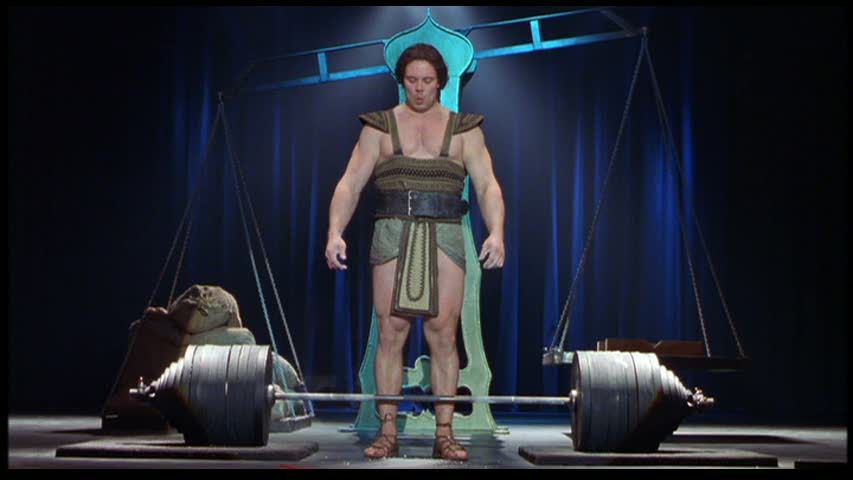
There are apparently several films by this name, but only one was directed by Werner Herzog. I have to admit, I was pretty skeptical of the plot at first (Jewish strongman performs in a Nazi circus to pay off a debt), thinking it too mawkish and unreal, until I read online that it was based on the true story of Zishe Breitbart, Polish blacksmith-cum-folk hero.

The movie itself was very well done and I highly recommend it, but the "trivia" listed on its IMDB page are too good  not to pass along:

"An elderly woman who lived in one of the houses near where the marketplace scenes were shot once stepped out into it with a shopping bag and, even though director Werner Herzog told her it was just a movie set, insisted on shopping and interrupted the shoot for 15 minutes."

"Jouko Ahola, who plays the strongman [Zishe], is an actual strongman and actually lifted the weights as seen in the film."

Yes, he lifts that (he even acts, too!).
"After two minutes of the hypnosis scene, the cinematographer started to weave and his head sunk back. Herzog grabbed him and put him softly back to the camera where he continued. Not only that, but Roth was actually able to hypnotize the young woman as well, again Herzog stating that one 'cannot act waking up from hypnosis' like we see in the film."

This is because Tim Roth (who plays the mystic Nazi hypnotist cabaret manager) is so seductively good he probably is in league with the devil. I am very sorry for you, dear reader, that I was unable to find any good clips of him in this film online. All I could find was this, which in no way does justice to his performance, or his ability to, er, hypnotize suggestable young women.

THE LAST STATION (2009)

It's no news to anyone that I'm not exactly Tolstoy's biggest fan, and this biopic chronicling his last months did nothing to raise him in my esteem. This is another one I only saw the last half of, and while what I saw was good, what I did want to draw your attention to was this:


That's Paul Giamatti as Vladimir Chertkov, a devotee of Lev Nikolaevich's so ardent it was said that he was more Tolstoy than Tolstoy himself. 

That's a painting of Chertkov by Ilya Repin completed about seventy years before Paul Giamatti was even born.

I guess we know how an American slipped into this film now.

BAD LIEUTENANT: PORT OF CALL NEW ORLEANS (2009)

(Herzog's really not very good with the naming thing, is he?) I put off watching this movie for weeks, figuring from the title it was just some cheap cop thriller Nicolas Cage did to pay off Dog the Bounty Hunter, but it's actually a hell of a lot of fun (in a wild hedonistic desperation kind of way-- sort of like Leaving Las Vegas meets Vampire's Kiss meets 8MM meets Lord of War... it's a Nic Cage movie, okay?). He plays a drug addicted, iguana hallucinating sergeant (later lieutenant) in post-Katrina New Orleans. The plot doesn't really matter, it's all just an excuse for him to run around saying things like, "Shoot him again, his soul is still dancing."

If you don't like Nicolas Cage doing his Nicolas Cage thing, you probably won't like this movie-- though again, I have to wonder what you're doing reading this blog (Cage, Waits, and Dostoevsky sum me up about as well as anything can).

Here is one of the many scenes in which he is on crack:


Almost enough to make a gal pro-drug war (how art survives in Portugal I just haven't the foggiest).

Monday, May 16, 2011

Sobornost' Man

The following is taken from a conversation I had via text with a friend writing a paper about secularism in Russia. I have left out all of his responses; mine are unedited.

"Haha yeeeah. Blame the Germans."

"It's always the Germans. Or the Austrians, for non-Russian Slavs. Everything and always. I bet the IP is a Habsburg front group."

"EXACTLY. Werner Herzog would be a great Slavophile."

Friday, March 25, 2011

We have always been at war with Soviet Realism

My Ear-Trumpet Has Been Struck By Lightning never fails to fascinate, and if I blogged about every post that caught my eye this would cease to be a crypto Waits commentary blog and become a crypto Ear-Trumpet commentary blog. That said, I couldn't let his recent posting of an Abel Grimmer painting slip by unnoticed:
"Carrying the Cross" - Abel Grimmer, 16th century
Abel Grimmer was 16th/17th century painter of the Flemish baroque school. Don't worry, I'm not suddenly expanding the roster of countries with which I'm obsessed to include Belgium-- this painting struck me because its use of perspective reminded me vaguely of some early Muscovian manuscripts (yes, yes, EDISPD).
The Kremlin, 16th century
Crowds implore Mikhail Romanov's mother to let him to go Moscow and become Tsar (really), 17th century
Construction of the Kremlin, 16th century
Boy, the perspective looks screwy! Contrary to popular belief, this is not because the early Russians were subhuman gold-worshipping bear-eating creatures incapable of discerning shadow from light or near from far. As it was told to me, at least, early Russian manuscripts portrayed people and places in proportion to their importance to the scene. Surprisingly ten minutes of Google image searching didn't yield up ideal examples of 16th century depictions of Uspenskiy Sobor, but if you're ever lucky enough to come across such things, you'll note that the religious buildings are always larger than the secular ones surrounding it, and that the important people (Patriarchs, Tsars, Saints) are larger than the random boyars and whatnot surrounding them. Conscious rejection of realism! How neat.

Thursday, March 17, 2011

Oh, right, St Patrick's Day

Good things that are at least somewhat Irish include:

1. My childhood hero Denis Leary


"I love to smoke. I smoke seven thousand packs a day, okay? And I am never fucking quitting! I don't care how many laws they make. What's the law now? You can only smoke in your apartment, under a blanket, with all the lights out? Is that the rule now, huh?

The cops are outside, 'We know you have the cigarettes. Come out of the house with the cigarettes above your head.'

'You'll never get me, copper! I'm never coming out, see? I got a cigarette machine right here in my bedroom. Yeah, see, yeah!'"

This routine is nearly twenty years old.

2. The Pogues


"If I should fall from grace with God
where no doctor can relieve me
If I'm buried 'neath the sod
but the angels won't receive me

Let me go, boys
Let me go, boys
Let me go down in the mud
where the rivers all run dry."

3. Guinness: not actually very good, but reliable and omnipresent. When all else fails, when you're in a strange land, when the world collapses around you, when you've forgotten your own name... Guinness can be your inscrutably dense, watery, bitter, cloying anchor.


4. St Patrick's Breastplate Prayer: Did St Patrick actually write it? Does it matter very much?

"Christ be with me, Christ within me,
Christ behind me, Christ before me,
Christ beside me, Christ to win me,
Christ to comfort and restore me.
Christ beneath me, Christ above me,
Christ in quiet, Christ in danger,
Christ in hearts of all that love me,
Christ in mouth of friend and stranger.

I bind unto myself the Name,
The strong Name of the Trinity;
By invocation of the same.
The Three in One, and One in Three,
Of Whom all nature hath creation,
Eternal Father, Spirit, Word:
Praise to the Lord of my salvation,
Salvation is of Christ the Lord."
Whole thing here.

5. Father Ted

Monday, March 7, 2011

The Sieve: Black Lamb and Grey Falcon

Black Lamb and Grey Falcon is a travelogue/amateur anthropological work about interwar Yugoslavia written by Englishwoman Rebecca West published in 1941. It was given to me as a 21st birthday present shortly after my return from Russia, and despite its nigh-1200-page length is incredibly engaging and eminently readable, regardless of whether you know much about the Balkans (though it is clearly more enjoyable if you do!).
"'A woman must not spring about like a man to show how strong she is and she must not laugh like a man to show how happy she is. She has something else to do. She must go round wearing heavy clothes, not light at all, but heavy, heavy clothes, so that she is stiff, like an icon, and when she dances she must move without seeming to move, as if she were an icon held up before the people. It is something you cannot understand, but for us it is right. Many things in our culture accord with it.'"
The above excerpt is Constantine explaining the failings of a Croatian folk dancer to Dame West's (English) husband, who failed to understand why her dances were "shocking" and "terrible". Chapters earlier she introduces him:
"There was Constantine, the poet, a Serb, thaht is to say a Slav member of the Orthodox Church, from Serbia. ... He is perpetually drunk on what comes out of his mouth, not what goes into it. ... Of all human beings I have ever met he is the most like Heine: and since Heine was the most Jewish of writers it follows that Constantine is Jew as well as Serb."

Saturday, September 4, 2010

The Sieve: The Strong-Woman Motif

Given that I may or may not have been literally sleeping in a library for the past few days, I've spent a lot of time browsing shelves. Around 4am a few nights ago I happened upon a dusty old volume titled The Transformation of Russian Society, originally published in 1960. It's essentially a thick collection of academic papers addressing various aspects of Russian and Soviet culture, but the one I'm about to excerpt for you, "The Strong-Woman Motif", stuck out to me. It doesn't seem to be available anywhere online, either, so consider this my mitzvah for the day. Bolded are bits I especially liked/found provoking.
"The glorification of women in current Soviet fiction is more convincing than that of men. The heroine, in contrast to the hero, shows consistently fullness of character: tsel'nost'. It is a multifaceted character of wide range, encompassing positive qualities such as selflessness, endurance, generosity, ability to adjust to stress, ability to solve immediate problems. One of the foremost properties of tsel'nost', a term much less fuzzy than 'wholeness,' is unselfconsciousness. Moreover, in contrast to the man, the woman represents strength which is derived from an ability to relate actively to society, to the collective, to the family.

...

The strong-woman motif finds no parallel in a series of male counterparts, who, to begin with, frequently stand for ideas. The heroine preempts the hero's place. She might even personify a reproach against the restlessness, escapism, and narrowness found in the Onegins, Chatskys, Pechorins, Beltovs, Raiskys. Strong men seem to be punished for their masculinity and self-assertion with early death. This is the case with Bazarov, Insarov, Bolkonsky. The longevity and softness of the slumbering Oblomov, the giant of low vitality, makes the point.

...Men qua men are disappointing. Oblomov is incapable of the simplest salvation offered him by Olga. The technicalities of a wedding are too much for him. Onegin, stronger by far and man that he is, assumes the frustrating posture of brotherly love...

The singularly non-Victorian heroine gives herself spontaneously and, if need be, commits adultery for the sake of full participation. Tatiana's dream marks the acceptance of Onegin's dangerously evasive reality and her strength is expressed in that frustrating surrender... The very motif of the strong woman makes it possible to mention Ostrovsky's untutored, primitive Katerina side by side with the refined gentlewomen. He presents her as a result of an oppressive milieu of the heavy and cruel kupechestvo. But the important thing is that Katerina acts when driven toward fulfillment. Having enacted the storm of her life, she leaves her weak husband to his desolation and in envy of her courage. Her lover likewise is weak while in contrast Katerina's strength is monumental.

...

The courage to involve oneself fully was seen in its connection with the feminine ability to love and to act. The nuptial scene in On the Eve is a motto for many novels. Insarov warns Elena of the hardships ahead: exile, poverty, humiliation. To all this she replies: 'I know. I know everything... I love you.' 'Welcome, then, my wife in front of the people and in front of God!'

Elena knows. But Nekrasov's countess, Volkonskaia, does not. A bride at eighteen, raised in the greenhouse of the Pushkin era, she has no notion of her husband's political activities. She hardly knows him. When he is arrested, unquestioning loyalty determines her martyrdom--in her mind, he cannot be dishonorable. ... When she joins her husband in a Siberian mine, she kneels before him and kisses his chains. Astonishing as it may seem, this romantic narrative has never been considered sentimental. This is germane to the argument of the extra-literariness of the motif. Nekrasov measures integrity in terms of commitment to primary loyalty in the face of threats, both intrinsic and extrinsic. If there is anything this young woman knows it is that the state, the tsar, the mighty are wrong. Her loyalty is of an ecstatic nature, and her strength rests in love.

It is notable that the 'strong man' is reluctant to entier into primary loyalties. Chernyshevsky spelled out the program of abstinence for his bristling radical. Innocence, generosity, spontaneity, essential ingredients of tsel'nost', are not Rakhmetov's qualities. He has no drives--he is all brain...

Gorky's victim of 1905, the revolutionary Pavel, admonishes an underground comrade against marriage: 'You shall live for the sake of a piece of bread, for your children, for your house; and you shall both be lost to the cause, both!'

...The denial of love is an essential attribute of the revolutionary man who fears dissipation of strength, diffusion, submersion in autrui...

Oblomov can do only one thing: submit. Raskolnikov's cerebration, far from being submissive, represents also only one state: alienation. The split in Raskolnikov, as the name implies, describes him fully. He indeed stands in contrast to tsel'nost'. In Russian fiction, only a man can be so split. To be sure, only a man can be a Prince Myshkin. The Idiot's impotence, Raskolnikov's alienation, Oblomov's phlegma, all are unthinkable in a heroine."
This will not be the last you see of this article.