Showing posts with label Live from Russia. Show all posts

Friday, July 6, 2012

BLESSED XENIA PETERBURGSKAYA: The Mad Widow

First: love the questions and comments my last post got! Please keep 'em coming; just because I take forever to respond doesn't mean I've forgotten or don't care.

Now to business! Eve asked a great question: "Were there ever married holy fools?"

I started writing this hours ago and it's turned into a beast of an answer, so I'm going to break it up into a series of meandering posts. Because I'm doing this for my edification as well as yours, I'm letting myself go off on tangents (within reason)-- I'll try to include a tl;dr summary at the beginning of each post and a master one at the end when I've exhausted the ten different essays I'm going to write in the course of answering this question.

TL; DR Version of "The Mad Widow"
- St Xenia became a fool-for-Christ following her beloved husband's death, possibly in an attempt to "compensate" for the fact that he died suddenly with neither Confession nor Communion
- Xenia's adoption of her husband's name and clothing after his death can be read as a harbinger of her theosis; in taking on aspects of his life she empties herself and obliterates her ego (think about that next time you see a crowning at an Orthodox wedding!)
- that Xenia's love for her husband is a driving element of her narrative makes hers an unusual vita; most female vitae include virginity chosen at a young age, forced or abusive marriages, or say very little about the husband at all
- love of the poor and love of man-made beauty need not preclude one another (hiya Calvinists)
- Orthodox glorification isn't exactly the same as Catholic canonization but I won't tell you why til you're older

Essential Russian!
iurodstvo  - holy foolishness
klikushestvo  - a shrieking ailment indicating witchcraft/sorcery-induced demonic possession 

BLESSED XENIA PETERBURGSKAYA: The Mad Widow
Transliteration note: in my opinion "Kseniya" makes much more sense than "Xenia" (from the Russian Ксения), but "Xenia" is the standard English transliteration, so out of respect for local tradition (read: *search optimization*) I'll stick with that one.

Upon seeing Eve's question, I thought immediately of the widow holy fools, like the famous St Xenia of Petersburg. St Xenia gave away all of her possessions and wandered the city as a beggar after her husband's death sometime in the mid-18th century. I actually had the great privilege of visiting the chapel built over her grave in Smolensky Cemetery in Petersburg in 2010.
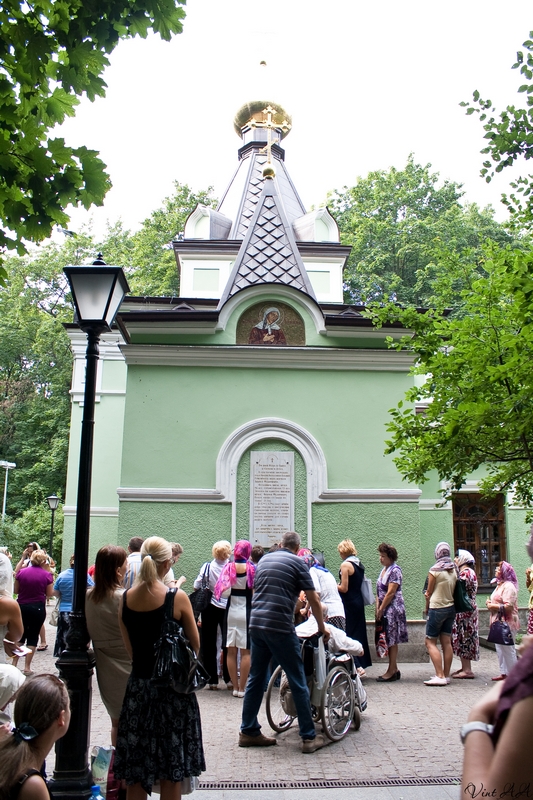
Часовня Ксении Блаженной, Смоленское Кладбище, Санкт-Петербург
St Xenia's Chapel, Smolensky Cemetery, St Petersburg (source)
"WHOEVER KNEW ME, PRAY FOR MY SOUL THAT HIS OWN MAY BE SAVED"*
St Xenia's Chapel

Blessed Xenia is the patron saint of Petersburg and is especially beloved among women, who pray to her for intercession in family troubles. While being a wife or mother is never simple, in a country whose gender balance is still recovering from a century of warfare, where less than twenty years ago life was so difficult that male life expectancy plummeted to 56 (and even today is ten years below that of western European countries), where alcoholism kills millions every year, and children begin drinking heavily before high school, the cross women bear as the rock of family and society must be especially heavy. 

When I was there, the line to simply touch the walls of the small chapel was incredibly long-- women, young and old, all in head scarves, some with children, some with canes. I remember one woman posing a sickly young boy on crutches in front of the chapel for a photograph-- I can't know because I didn't ask her, but if she'd been documenting a pilgrimage for her parish I wouldn't have been surprised; many people travel from great distances to visit the shrine. Many light candles, some leave prayer notes-- I have been to few pilgrimage sites, and don't know whether that is common practice in Orthodoxy, or a particularity of supplication at St Xenia's Chapel (my instinct suggests the latter).

From the parish blog of the Righteous St John of Kronstadt Orthodox Church**:
"В советские времена в часовню нельзя было попасть – доступ поклонникам был закрыт, но люди все равно шли, прикладывались к ограждению с верой. С тех пор сохранилась традиция – поклонники обходят здание часовни с молитвой, прикладываются и целуют стены."
(Translation mine, proceed with caution.)
"In the Soviet era, it was forbidden to go into the shrine - access was closed to worshippers, but people went all the same, venerating at the fence [built by the Soviets to keep people from the chapel -TKB] in faith. Since then the tradition has been preserved - worshippers go around the chapel building to pray, venerate, and kiss the wall." 
Not every saint gets her own chapel, much less before she's been officially glorified (see below), but it is an honor perhaps especially worthy of St Xenia, who herself assisted with the construction of a church in the very cemetery in which she would later be buried. At night after the workmen had gone home, she would either bring large stones to the construction site, or carry the stones meant for the highest levels to the top of the scaffolding (depending on which vita you read). I like this story in particular because it illustrates that asceticism and appreciation of beauty need not contradict one another-- she herself went about in rags, ate little, and gave constantly of herself, but also dedicated her energy to building a new house of God in a city already full of them. Extremism in the pursuit of beauty is no vice!

PRECIOUS STONES ADORNING THE RAIMENT OF THE BRIDE
On Orthodox Glorification
Entire essays could be written on this alone, but for now I'll say simply that overall the Orthodox approach to numbering the saints is more decentralized and less defined than that of the Catholics. I was shocked when I first found out that Xenia hadn't been glorified until 1988 (to be fair, in 1978 by ROCOR, but that, too, is quite late). Her figure has loomed large over Russian history and culture since not long after her death around 1800; pilgrimages to her grave site began in the 19th century, and attachment to her was so strong that not even Soviet Leningrad could erase her from the hearts and memories of the faithful. I haven't looked into her case specifically, but from what I've read about the institutional glorification of other saints, the Church seems content to observe "local" veneration for quite long periods of time before beginning any official proceedings. Unexpected blessing of this approach: we can watch scenes from St Xenia's 1978 glorification service on Youtube!

FOR HIS SAKE: Sacrificial Foolishness?
Unusually for a female saint, the vitae are very clear that she loved her husband very much; some even imply that her holy foolishness was prompted by mad grief. Even more curiously, she responded only to her husband's name (Andrei Feodorovich); some stories say that she went about in his clothes. While she was not glorified by the Russian Church until 1988, veneration of her among the people is said to have begun even during her lifetime. We do know that by the end of the 18th century, locals referred to the street on which she and her husband had lived as Petrov Street, which was her husband's surname.

Some vitae say that taking on her husband's name, as though she had completely forgotten her own (and perhaps she had), is an illustration of the depth of her humility (see: kenosis); others feel less of a need to editorialize. Unfortunately I'm only looking through what's quickly available online, so I can't find out for how long that particular theory's accompanied her vita. I can say the adoption of the husband's name is quite idiosyncratic and not something I've seen elsewhere, although there are many stories of holy women in which either their birth names are not given, or no name is given at all (sometimes, in fact, as a story grows in popularity, an anonymous saint will be given a name, as with the Egyptian monk we now revere as Isidora).

An element sometimes emphasized in Xenia's story is that her husband died unexpectedly while drinking at a party and in a state of sin (without having taken the Blessed Sacrament). Some write that it was Xenia's concern for the state of her husband's soul that drove her to such fervent prayer, others that the suddenness of his death gave her eyes to see the frivolity and selfishness of her life and the strength to change course.

THE OLD BALL AND CHAIN: Of Witches and Wives
More typically widow saints (as relayed in the vitae) were forced into marriages against their will, or express no particular feelings about their husbands at all-- their deaths are rarely portrayed as joyous events, of course (a subtle tone of relief is sometimes conscioned), but as welcome developments giving the widows the freedom to pursue a more perfect holiness.

Holy foolishness among women, whether married or not, deserves examination in its own right, particularly in a country some of whose rural populations maintained belief in sorcery past the Revolution. The problem of klikushestvo (the shrieking ailment) in particular comes to mind. As Linda Ivanits explains in Russian Folk Belief, klikushestvo is "primarily a woman's condition characterized by howling, cursing, and falling to the ground during the liturgy, in the midst of church processions, or in the presence of icons, incense, and other religious objects," and usually signifies demonic possession brought on by malevolent sorcery. It was considered distinct from "hysteria" by peasants and doctors alike, and did not merit the same treatment. 

Not all holy fools were prone to loud outbursts or wild displays in church, but some certainly were. According to Ivanits, klikushestvo was a well-known ailment in villages throughout the Empire, with records of klikushi (shriekers) going back to the 16th century.   

The difficulty of distinguishing holiness from sin is almost definitionally present when studying iurodstvo, but concerns about witchcraft, hysteria, and the suspicion with which female wanderers must have been regarded makes those who were known as holy fools during or shortly after their lifetimes all the more incredible. Even the gift of prophesy, often cited to legitimize the holiness of the fool (and which Xenia, for example, is always noted to have had), was far from universally regarded as one given by God.

COMING SOON 
"WILDFLOWERS OF GODRebellion and the Iurodivaya"
Potentially but not definitely including some or all of the following (and probably some things not even listed)...
  • Hell's Angels? the inherently transgressive nature of iurodstvo
  • All the world's a stage: transvestitism among the saints
  • That ain't a tiara: marriage and martyrdom in Orthodoxy
  • Neither Jew nor Greek, neither Cuban cigar nor light cigarette: why aren't there more female saints?
As always, questions and comments wholeheartedly encouraged!

*"Кто меня знал, да помянет мою душу для спасения свой души." - carved on St Xenia's gravestone.

**Didn't even notice the name until I looked to link back! Dear Batiushka John really is everywhere. This is, interestingly, a Moscow Patriarchate Church in Hamburg, Germany, with quite an interesting history
"In 2004 the Gnadenkirche [Grace church] church in the center of the city came to [converted to; joined] our parish. The miracle of gaining a large congregation in our own home in Hamburg was made possible by longstanding good relations between the Evangelical Church of Germany and the Orthodox Church of Russia. The parish bought the church land in Hamburg and transferred it for a nominal fee - 1 euro." (В 2004 г. церковь Гнаденкирхе в центре города перешла нашему приходу. Чудо обретения многочисленной общиной своего дома в Гамбурге стало возможным благодаря давним добрым отношениям между Евангелической Церковью Германии и Православной Церковью России. Приход выкупил земельный участок под храмом у города Гамбурга, а само здание было передано за символическую плату – 1 евро.) 
The story of both this building and the parishes its housed is fascinating to me; remind me to do a post focusing on it soon if I forget!

Sunday, July 1, 2012

[TSE] Holiness or Heresy: Evolving Models of Iurodstvo in Medieval Russia

Notes for the Reader
Excerpts will be posted unedited; will post my own commentary at the end. All senior essay related posts will be tagged "Batiushka Ioann". Footnotes will appear at the bottom of each excerpt. Prologue here.
Questions, critiques, and reactions of any kind warmly encouraged; I am looking to strengthen and improve. Please remember that this is essentially a hastily written draft.
Writing about theology and Church history as an inexperienced believer for a secular academic audience is harrowing. Don't ignore weaknesses and errors, particularly if they could be interpreted as heretical or blasphemous, but be cognizant of my constraints.

II. Holiness or Heresy: Evolving Models of Iurodstvo in Medieval Russia

The tradition of holy foolishness, a particularly enigmatic genre of sanctity, originates in the Gospel itself; Paul of Tarsus mentions a connection between foolishness and the Divine several times in his First Letter to the Corinthians, but of particular relevance is this passage: “Let no man deceive himself. If any man among you seemeth to be wise in this world, let him become a fool, that he may be wise. For the wisdom of this world is foolishness with God. For it is written, He taketh the wise in their own craftiness.”The lived tradition of foolishness-for-Christ began in Byzantium, but it was in medieval Muscovy that the practice became most well-known. The Russian holy fool (iurodivyi) soon took on a particular role: he was not merely a man conquering pride through madness and humiliation, but “a form of divine control over the state authorities.”This other-worldly rebuke of secular power is famously illustrated in the confrontation between Nicholas of Pskov and Tsar Ivan IV, in which the fool sends the Tsar a piece of bloody meat to chastise him for his massacres. Importantly (in legend, if not in historical fact), Ivan repents, and orders the city spared.

By the seventeenth-century, however, the protective aura of dread and wonder that had largely shielded the iurodivye from institutional persecution had begun to dissipate. Patriarch Iosif in 1646 barred them from entering churches, “since their shouting and squealing prevents Orthodox Christians from hearing the divine chanting, and they come into God’s churches like robbers, carrying sticks…”9  Instructive is the story of another Sergiev, called Ioann the Big-Cap of Moscow, whose life provides an example of the interplay between temporal authority and manifestation of holiness.

He was born around 1670 into a peasant family and spent most of his life wandering from monastery to monastery. Unlike many holy fools, it seems that he wanted to become a monk. Because of Peter I’s ecclesiastical reforms, Ioann, as an illiterate peasant, was prohibited from being tonsured—unless he could convince the highest court to grant an exception and obtain a Synodal dispensation. As Aleksandr Lavrov notes, “one may well wonder how an illiterate could ever have obtained the latter. For most people, therefore, the path to monastic asceticism was simply closed. For this reason, in examining religious recluses…we must consider as motives not only a certain sense of footloose self-determination but also the pressure exerted by the dominant religious culture that forced them to adopt alternative ways.”10  Unlike his forbears in iurodstvoIoann rarely ran afoul of authority, and was generally accepting of whatever treatment he was given: after the signing into law of a new regulation demanding that “there be no truck with anchorites and sanctimonious men with matted locks,” the Bishop of Vologda ordered him shorn, a castigation to which he meekly submitted.11 Nor could he be accused of heresy or schismatic sympathies: he regularly confessed and took Communion, and in spite of the tumultuous Sobor of 1666-7 in which the Old Believers were anathematized, he swore that he “recognized no schism” and “crossed himself with three fingers and not with two.”12 It seems that he was marked as a holy fool only by his heavy chains, iron cap, and aimless wanderings. All this notwithstanding he was captured in 1733 and “returned to his place of registration.”13

What happened in the 150 years separating Nicholas and Ioann? Despite late Muscovy’s low literacy rate (Gary Marker, estimating generously, pegs it below ten percent), highly public liturgical services combined with mass migration spurred by the Time of Troubles to disseminate tales of iurodstvo throughout and across cities and villages.14 As popular veneration grew, the Church became increasingly wary, striking names from prayer-books and speaking out publicly against the visible and behavioral markers characteristic of the iurodivye.15 Their renown was beginning to spread beyond her reach, and not in ways she welcomed. In Holy Fools in Byzantium and Beyond, Sergey Ivanov quotes the testimony of many foreign travelers to Russia who were surprised by the free reign given the iurodivye; some, like Isaac Massa, openly pitied the Russians for their gullibility: “…if I was the tsar I would order the last rite for her before it was my turn; but these Muscovites consider her holy; which is not surprising, since—alas—they are still mired in ignorance. May God enlighten them!”16

More serious are scenes from the iurodivye vitae in which they commit unpredictable acts of violence, such as Prokopii of Viatka killing an infant “to resurrect it later” and holding a knife to his confessor’s throat, or Simon of Iurevets strangling a priest with his bare hands.17 While in some sense these stories warn the faithful of the fundamental incomprehensibility of the fool’s actions, in another they are deeply subversive: “regardless of how the hagiographer tries to explain it—aggression against the priest is semantically significant as a sign of rebellion against the Church.”18

Here we see the tension between hagiography and mere narrative. The earliest holy fools were relatively isolated examples of eccentric holiness, fantastic aberrations that inspired awe and served as a kind of memento mirari, but as stories of their exploits were collected into vitae and became reified into a particular model for communing with the Divine, they took on the normativity of other saints’ lives, opening the door for ever increasing numbers of feral, bullheaded vagrants to roam the kingdom. Ivanov notes that “the emergence of at least one local iurodivyi almost inevitably called forth a wave of imitators.”19

While the prelates struggled to manage the destabilizing effects of popular iurodstvo, the iurodivye themselves were transforming. The first iurodivaya (female holy fool) appeared during the reign of Boris Godunov (1585-1598); like Nicholas of Pskov, she was wholly unafraid of anyone, including the tsar, and would often foretell future events.20 Despite the similarities, the modern observer must understand the strangeness of an isolated sixteenth-century woman taking on what had been an exclusively male role, particularly in an era still so concerned with sorcery that an explicit renunciation of it was included in the oath of allegiance to the tsar.21 Around the same time we also see hermits and nuns counted among the iurodivyethe inclusion of hermits is especially bizarre, since perhaps the defining characteristic of a holy fool is that he be among people—whether to humiliate himself, rebuke those around him, warn them of danger, or even simply arouse in them confusion or astonishment, but he that works to shut himself away from others, whether sane or mad, cannot properly be named among the iurodivye.

To more thoroughly understand how the holy fool changed throughout the seventeenth-century, it is instructive to break him down into his constituent parts. As previously established, he must be among people(“the world would rather have nothing to do with this madman, but he keeps on imposing himself on the world,”), he must be fearless (although he need not be aggressive or violent), and he may have special powers of prophesy, which he will use to warn the faithful, rebuke the sinful, prompt all to repentance, and, upon the fulfillment of prophesies, build confidence in his special relationship with God.22 His is a curious, worldly asceticism—he is almost always utterly impoverished and completely reliant on the charity of those around him, often rejecting it even when offered. He may starve himself, walk about naked or in chains, or incite violence upon himself. Typically he does not form close relationships with anyone, but he may have a spiritual confessor in whom he trusts and around whom he is at peace (though, as noted earlier, there’s no guaranteeing the safety of such confessors). He may wander across entire regions or stay within a particular village, but he does not own property, and incredibly rarely would he have any rank to speak of. He may or may not be schismatic; he may or may not be literate (though the latter is admittedly quite rare).

In short, he bears within him elements of the charismatic, ascetic, monastic, pastoral, apocalyptic, thaumaturgic, martyric—all that seem to be missing are the hermetic and the hieratic, curiously enough two opposite poles themselves, and yet their marked absence circumscribe who may or may not be called a holy fool. Now when in the seventeenth-century iurodivye adopt the wearing of fetters, a particular Russian modification to the tradition, we can contextualize the innovation somewhere between wholly irrelevant and paradigm shattering. Ivanov writes, “Byzantine holy fools did not wear fetters. That fetters came to seem necessary is a measure of the fading of that special aura which had earlier surrounded indecency and hooliganism in themselves. Thus later holy foolery sought new forms of legitimation.”23

That a holy fool might not only desire legitimation, but consciously hit upon how to secure it, might reasonably elicit no small degree of suspicion about the whole enterprise. However, when understood in light of, say, his prophetic role, it makes sense that somewhere he maintains a sense, not of dignity, but of whether and to what degree he is fulfilling his purpose.

Just as the iurodivye may seek irons to brace their message and purify themselves for their mission, the hagiographers understand that they, too, must bear the responsibility of effective communication, instead of hoping dumbly that they will be understood. Thus is explained, for example, the replacement of archaic names with more familiar ones in the seventeenth-century reprinting of a particular story about a monk and the Archangel Michael.24 Archbishop Feofan (Prokopovich) of Novgorod, Peter I’s chief apologist, likewise understood the potentially subversive power of the saints: hoping to marginalize what he deemed unacceptable models, regardless of existing traditions of veneration, he “ridiculed not only the holy fools of his day but even those already extolled by the Church as having been pleasing to God.”25

And so the reader of the hagiography is not one, but at least three conceptual steps from the saint himself—his idea of the saintly model is based on the text, but colored by his own associations and biases; the text is whatever happens when the hagiographer’s particular knowledge, abstract ideal, and writing skill intersect, and alone of the three that particular knowledge itself is nothing more than the memory of how the saint chose to present himself, he himself mediating his holiness through his preconceived ideas of piety, sanctity, and the good. Throw in hundreds of years between subject and scribe, or thousands of miles, or both; let the writer be ineloquent, uneducated, and myopic—or selfish, manipulative, and bright, or anything but a saint himself, and one might wonder how it is the Church has consistent models at all not drawn directly from Scripture (not that that isn’t fraught either, as some Protestants will attest). Hieromonk Makarios of Simonos Petra explains:
But the life of a saint cannot be reduced to an article in a Dictionary of Biography or to a chapter in Church History; it is a verbal icon of the saint that, while telling the story as accurately as possible, lets the hidden aspect of the work of the Grace of God in the saint shine through. Just as an icon can only be venerated in the context of worship with the appropriate dispositions, so the life of a saint can only be read in the Church with the eyes of faith and not according to the criteria of secular scholarship. … Although in the life of ascesis and inner prayer (noera prosevchi) all forms of imagination are excluded, our tradition, seeing how strong imagination and representation are within our nature in its fallen state, makes its own their power, which for man without God is a source of division, and transfigures them in iconography and in hagiography, so that they become a genuine means of entering into communion with God and with His saints.26
The Church therefore protects her models, but does so through active contemplation and consciously particular forms of veneration. Archimandrite Justin Popovich calls the lives of the saints “applied dogmatics… In reality they are the testimonies of the Acts of the Apostles, only continued throughout the ages.”27 Veneration of a saint takes many forms, as Hieromonk Damascene (Christensen) writes, “Besides our private prayers for them, the Church offers us many other ways of communing with them as our friends and honoring them as our preceptors. We sing their troparia, we venerate their icons, we perform services to them, and with a blessing from a Bishop we can even compose services in their honor.”28

The lowly parish priest, however, has rarely been recognized as one of the “gold and precious stones that adorn the raiment of the Bride.”29 If he is considered it all, it is only in light of the necessity of his function. He is a man with a job, in fact, a man constituted solely of his job—one that is sometimes sacerdotal, sometimes pastoral, but nothing of particular interest. The historical Orthodox white priest is reduced broadly to the political and ecclesiological regulations circumscribing his sphere of influence and setting the boundaries of his quality of life. The much-noted absence of glorified white priests prior to Father John’s certainly contributes to this—there are no vitae, no folk stories. But what did the priests themselves make of their vocation, particularly if, as (Saint) Justin Popovich explains, “the Lives of the Saints contain in themselves Orthodox ethics in their entirety,”?30 The intense debates surrounding the nature of the clerical caste beginning in earnest in the early nineteenth century show a church wrestling with the nature of the sacerdotal genre: trying to overcome its lowly status, arrive at an agreed upon mission and purpose, and make of a hodgepodge of canon law and worldly regulation a relevant and inspiring model.
- - - - - - - - - -
7. The King James Bible, I Cor 3:18-19.
8. Ivanov, Sergey. Holy Fools in Byzantium and Beyond. Oxford: Oxford University Press, 2006: 285.
9. Ivanov, Sergey. Holy Fools in Byzantium and Beyond. Oxford: Oxford University Press, 2006: 311.
10. Lavrov, Aleksandr. "Witchcraft and Religion in Russia, 1700–1740." Russian Studies in History 45.4 (2007): 23.
11. Lavrov, Aleksandr. "Witchcraft and Religion in Russia, 1700–1740." Russian Studies in History 45.4 (2007): 26.
12. Lavrov, Aleksandr. "Witchcraft and Religion in Russia, 1700–1740." Russian Studies in History 45.4 (2007): 24.
13. Lavrov, Aleksandr. "Witchcraft and Religion in Russia, 1700–1740." Russian Studies in History 45.4 (2007): 26.
14. Marker, Gary. "Literacy and Literacy Texts in Muscovy: A Reconsideration." Slavic Review 49.1 (1990): 89, Moon, David. "Peasant Migration and the Settlement of Russia's Frontiers, 1550-1897." The Historical Journal 40.4 Dec. (1997): 859-893.
15. Ivanov, Sergey. Holy Fools in Byzantium and Beyond. Oxford: Oxford University Press, 2006: 309-311.
16. Ivanov, Sergey. Holy Fools in Byzantium and Beyond. Oxford: Oxford University Press, 2006: 312-313.
17. Ivanov, Sergey. Holy Fools in Byzantium and Beyond. Oxford: Oxford University Press, 2006: 324-327.
18. Ivanov, Sergey. Holy Fools in Byzantium and Beyond. Oxford: Oxford University Press, 2006: 326.
19. Ivanov, Sergey. Holy Fools in Byzantium and Beyond. Oxford: Oxford University Press, 2006: 318.
20. Ivanov, Sergey. Holy Fools in Byzantium and Beyond. Oxford: Oxford University Press, 2006: 312.
21. Ivanits, Linda. Russian Folk Belief. Armonk: M. E. Sharpe, Inc, 1992: 87.
22. Ivanov, Sergey. Holy Fools in Byzantium and Beyond. Oxford: Oxford University Press, 2006: 357.
23. Ivanov, Sergey. Holy Fools in Byzantium and Beyond. Oxford: Oxford University Press, 2006: 344.
24. Ivanov, Sergey. Holy Fools in Byzantium and Beyond. Oxford: Oxford University Press, 2006: 332.
25. Lavrov, Aleksandr. "Witchcraft and Religion in Russia, 1700–1740." Russian Studies in History 45.4 (2007): 27.
26. Makarios of Simonos Petra. The Synaxarion: The Lives of the Saints of the Orthodox Church. Vol. 1. Chalkidike: Indiktos Publishing Company, 1998. 6 vols.
27. Popovich, Justin. Orthodox Faith and Life in Christ. Belmont: Institute for Byzantine and Modern Greek Studies, 1994.
28. Christensen, Damascene. "The Place of Lives of Saints in the Spiritual Life." The Orthodox Word 37.6 Nov. (2001): 261-281.
29. Makarios of Simonos Petra. The Synaxarion: The Lives of the Saints of the Orthodox Church. Vol. 1. Chalkidike: Indiktos Publishing Company, 1998. 6 vols.
30. Popovich, Justin. Orthodox Faith and Life in Christ. Belmont: Institute for Byzantine and Modern Greek Studies, 1994.
- - - - - - - - - -
Commentary
These notes serve two main purposes: to remind me what to fix when I go back and edit, and to seek your input on specific issues of concern to me. They will not always be interesting. 

- I could read and write about holy foolishness all damn day.

- draw parallels between "popular" religion of (some) of the holy fools and Fr John's "populist" liturgical style?

- dissemination of tales of iurodstvo contra various forms of press coverage as Fr John gained nororeity?

- Do I footnote too obsessively? I was never really taught any norms on when not to footnote.

- Every bloody time I read this sentence I have to read it twice to get it right: "Despite late Muscovy’s low literacy rate (Gary Marker, estimating generously, pegs it below ten percent), highly public liturgical services combined with mass migration spurred by the Time of Troubles to disseminate tales of iurodstvo throughout
and across cities and villages." Need to just rewrite it already.

- really like the idea of exploring the tensions between hagiography and narrative/folklore and/or biography. revisit later in paper, expand, something?

- proud of coining the phrase memento mirari. just saying.

- holy fools bred imitators, Fr John (unwittingly) spawned cultist devotees. explore/theorize about difference? social status, press, liturgical role, rural v urban, thaumaturgy.

- parallelism: break down what an Orthodox priest is later in the paper in the way a holy fool is broken down here? not enough focus on what the priesthood is, not enough of a sense of how the paradigm is broken in later sections.

- still love that the wearing of irons is a specifically Russian mod.

- do I veer too much into apologetics?

- should I explain what
sainthood means in Orthodoxy? probably.

- the enthusiasm of this quote always makes me smile: "We sing their troparia, we venerate their icons, we perform services to them, and with a blessing from a Bishop we can even compose services in their honor." Is it wrong to picture a hieromonk jumping up and down at the thought of writing a service for a favorite saint, or even while reflecting that his Church might allow him to? Took restraint not to make that period an exclamation point.
- do I need to explain that "glorification" and "canonization", and sometimes "veneration", in context of discussion of saints, mean the same thing? is it on me to explain how Orthodox theology of sainthood differs from the Catholic understanding? ergh. the differences aren't even constant across decades and Churches. 

Friday, June 29, 2012

[The Senior Essay] Introduction

Notes for the Reader
Excerpts will be posted unedited; will post my own commentary at the end. All senior essay related posts will be tagged "Batiushka Ioann". Footnotes will appear at the bottom of each excerpt. Prologue here.
Questions, critiques, and reactions of any kind warmly encouraged; I am looking to strengthen and improve. Please remember that this is essentially a hastily written draft.
Writing about theology and Church history as an inexperienced believer for a secular academic audience is harrowing. Don't ignore weaknesses and errors, particularly if they could be interpreted as heretical or blasphemous, but be cognizant of my constraints.

Icon & Iconographer:
Father John of Kronstadt and the Emergence of Sacerdotal Sanctity in Late Nineteenth-Century Russia
I. Introduction

In Dionysius of Fourna’s eighteenth-century iconography manual, one finds a curious instruction: “Draw a monk crucified on a cross, clothed in a tunic and a monk’s hat, barefoot and with his feet nailed to the footrest of the cross; his eyes are closed and his mouth shut. Just above his head is the inscription: ‘Set a watch, O Lord, before my mouth; keep the door of my lips.’”1 He continues, describing the monk’s chest, stomach, legs, and so on, at each point specifying a different prayer (“Create in me a clean heart… Prepare your feet in the Gospel of Peace…”), before explaining how to depict “the all-devouring Hell,” the “Maker of lust,” “Death and the grave,” and finally Christ Himself, above the Cross. “Then write this title: The life of the true monk.”2

It makes for a striking icon, not just because the monk is in place of Christ, but because he is no particular monk at all. He is a cipher, an image to which all monks must aspire (and indeed this icon is most commonly found just outside monastic refectories). More than most this icon highlights the monastic genre of holiness—it is a didactic icon, not meant for veneration of and communion with any individual saint, but for contemplation of and instruction in the ways of a particular model of sanctity.

It is commonly heard among Orthodox Christians that saints are living icons, and in fact it is with this idea that Nadieszda Kizenko begins her recent biography of John Sergiev, the renowned “Father John of Kronstadt”, who was glorified as a saint by the Russian Orthodox Church Abroad in 1964, and by the Russian Orthodox Church herself in 1990.3 He is now remembered best as a sort of latter day defender of “Orthodoxy, autocracy, and nationality,” the reactionary cultural program championed by Tsar Nicholas I and his Minister of Education Sergei Uvarov, so counter to the revolutionary atmosphere that surrounded Father John in the last years before his death in 1908.4 Yet to reduce the complexity of his life to a flat religious conservatism is to ignore his greatest “creation”, as Kizenko puts it: the salvation of his own soul.5

As the son of a sacristan and a graduate of the St Petersburg Theological Academy, Father John was certainly familiar with the communion of saints and the depth and variety of holiness manifest thereby—despite this, he seems to have forged his own path to sanctity, eventually becoming the first parish priest to be venerated by the Russian Church.

This together with his many other idiosyncrasies (matrimonial virginity, living thaumaturgy, ascetic priesthood) has contributed to the idea that he is sui generis, or at least something approaching the founder of a new genre of sanctity. In 1909 Archbishop Nikanor (Kamensky) of Kazan wrote of him that “because people are different now, they need to be acted upon in new ways that are peculiar to them.”6 Even within his own era he was widely recognized as a breaker of established categories of religious life, and the wonder and confusion attendant on his ‘boldness before paradigm’ continues to this day. Yet a historical examination of the evolution of other genres of blessedness reveals that Father John’s trajectory was actually quite in keeping with the meta-tradition of expressive flexibility present in the Church since her founding. Genres of holiness, like icons, are didactic, and evolve, reify, and dissolve in response to the unpredictable contingencies of human society—they are models to be appropriated and internalized by the faithful, not for the sake of orthopraxy, but to guide them towards the fullness of right belief.
- - - - - - - - - -                             
1. Dionysius of Fourna. The 'Painter's Manual' of Dionysius of Fourna. Torrance: Oakwood Publications, 1990.
2. Dionysius of Fourna. The 'Painter's Manual' of Dionysius of Fourna. Torrance: Oakwood Publications, 1990.
3. Kizenko, Nadieszda. A Prodigal Saint: Father John of Kronstadt and the Russian People. University Park: The Pennsylvania State University Press, 2000:1.
4. Pipes, Richard. Russian Conservatism and Its Critics. New Haven: Yale University Press, 2005: 99.
5. Kizenko, Nadieszda. A Prodigal Saint: Father John of Kronstadt and the Russian People. University Park: The Pennsylvania State University Press, 2000:183.
6. Kizenko, Nadieszda. A Prodigal Saint: Father John of Kronstadt and the Russian People. University Park: The Pennsylvania State University Press, 2000: 184.
- - - - - - - - - -
Commentary
These notes serve two main purposes: to remind me what to fix when I go back and edit, and to seek your input on specific issues of concern to me. They will not always be interesting. 


- I hate the title. The paper was already a few days late when I wrapped it up, so I put down the first thing that came to mind and ran it over to the Slavic Department. My working title was "Living Icons, Dead Saints", but that sounded vaguely blasphemous to me.


СТАРЧЕСТВО ДОСТОЙНОЕ ИЗОБРАЖЕНИЕ 
- Came upon the monk icon entirely by happenstance: I was in the stacks rummaging about for books on the rural clergy and found a big gorgeous book almost entirely of full color illustrations of icons and liturgical art. It was in Russian, but I checked it out anyway. I'd flip through it when I wanted a distraction and stopped short the first time I saw the crucified monk. An ingenious friend of mine found a high quality PDF of the entire book online despite not speaking a word of Russian, and weeks later, when I was struggling to think of a hook to get the essay started, the crucified monk came back to me. Read more about this kind of icon here, and email me if you'd like a larger version of the image to the right.

- I usually like to have clever subheadings for each section.

- There are many formatting/style issues. Inconsistencies off the top of my head: whether and where to capitalize words like saint, icon, communion, church, and pronouns referring to God; how to refer to clergy; transliteration of names and words left untranslated; whether to translate names. Input from anyone with experience writing about the Church concerning academic writing conventions will be much appreciated.

- Don't like the word "founder" here: "at least something approaching the founder of a new genre of sanctity". Something like "herald" or "vanguard" is closer.

- Overall this is a very vague introduction and doesn't actually explain much about the essay (this will become clearer as you read more chapters). This is because I myself didn't know much about the essay when I wrote it, but once the rest of the essay is swept through and edited, it can be fixed.

[The Senior Essay] Prologue

I've been kidding myself since I submitted my senior essay to the head of my department in April that I'd go back and fix the many, many problems with it, but at this point I think the best approach is to make things...interactive (Academia 2.0).

Before we begin, some back story: as a Russian and East European Studies major, I was required to write what's called a "year long senior essay". That means that in both the fall and spring terms there's a spot on my transcript called "The Senior Essay"-- it's worth as many credits as a normal Yale course, but instead of going to lectures I was expected to research, write, and consult with an adviser of my choosing on my topic, culminating with the submission of "a substantial article, no longer than 13,000 words, excluding footnotes and bibliography."

A few words about my major: there are essentially two Russian majors at Yale-- mine, and the actual Russian major. This is something of a relic of the Soviet era, when there was both more of an interest in and demand for Russianists with strong backgrounds in history, politics, and the social sciences. My major requires courses in Russian history and social science focusing on Russia and/or eastern Europe, and at least four years' worth of language study. In my department, one's language proficiency could in theory be in a language other than Russian (Polish, Czech, Serbo-Croatian, etc), but because those languages are taught rarely or not at all very few people take that route. The other major requires only literature courses-- a lot of them-- at least two of which cannot be in translation (which, I'll point out, are not courses my Russian would've permitted me to take at any point in my Yale career).

I am the only person I know who picked a major her very first semester in college and never once entertained switching-- I briefly fantasized about doubling in history, but Yale is made very uncomfortable by double majors, and I didn't have the discipline for it. Why REES over Russian? The emphasis on history and politics was very attractive to me-- in fact it was sitting in the very first lecture of "Russia from the 9th Century to 1801" freshman year that I decided to be a professional academic Russophile-- and the less stringent language requirement didn't hurt either. 

Good thing, too, because over time REES became my own self-styled Orthodox theology/Church history major. While Yale does have a religious studies department, it's not any kind of place to study traditional Christianity, and I had little interest in courses like "The Sociology of Religion" or "World Religions and Ecology". Because it's such a small department (5/3021 in 2012, I believe) my Directors of Undergraduate Studies (they rotated often; kind of a Defense Against the Dark Arts type deal) were pretty flexible about allowing courses outside the department to count towards the major. "The Rise of Christianity: East and West?" I remember one saying. "Sure, it's foundational." I didn't end up taking that course, nor did I need the flexibility-- by the time I left there were very few Slav history or poli-sci classes I hadn't taken. Still, my professors knew that I had a strong interest in the Orthodox Church, and it was a comfort and a kindness that they didn't try to push me into a more conventional focus.

Typically responsible students start thinking about the topics of their senior essays toward the end of their junior years, to approach professors about being their senior advisers, if nothing else. One's relationship with one's senior adviser ought be relatively close-- not only ought he have some degree of expertise in the proposed topic, but he ought be someone with whom one either already has or can build a dynamic of comfort and mutual trust.

As some of you may know, after my junior year I was forced to take a year off, and while I could've thought ahead and contacted professors about my senior essay during my time off, I was too worried about being readmitted at all to take such a bold step. In August 2011 I was readmitted, though, and come September I was in quite a pickle-- there aren't too many Russianists at Yale, and even fewer with anything beyond a rudimentary knowledge of the Church. I hadn't thought anything through very much, let alone done any preliminary research, when my DUS called me in to ask how the adviser search was going. Everyone I'd asked (read: everyone who knew anything about Russian history) was already booked and couldn't take on any more advisees, and I couldn't very well not write about Russia! Owing to my unique circumstances my DUS agreed to "advise" me until our head honcho Russian historian (who was really ideal for me to begin with) got back from sabbatical the next term.

Suffice to say I did no work at all that first term, BS'd a two page long "prospectus" in December in which I babbled about Ober-procurator Pobedonostsev and the Holy Synod to avoid an F on my transcript, and had nothing at all to show my actual adviser when we first met in January. He rather promptly threw out the Pobedonostsev idea and told me that if I was going to research primarily in English, and wanted to write about the Church, I was essentially limited to Father John of Kronstadt or Vladimir Soloviev. I'd heard of them both, but knew more about Soloviev, so I started with Nadieszda Kizenko's biography of Father John, A Prodigal Saint. I finished it in about three days and never really looked back-- sorry Volodya!

While I did a reasonable amount of research, the essay itself I wrote over the course of a very strung out week, with the bulk of the writing happening in a 72 hour period. The more I read, the less it seemed there was to say about Father John-- whatever I was looking for, I wasn't finding, and entire books I'd read as background and taken heartbreakingly extensive notes on became completely irrelevant and unusable. By the end I was near constantly fantasizing about running off and wandering the country reading tarot for cigarette money. 

Eventually I did vomit something out, and I think there's a bit of potential tucked away in here somewhere. Let's find out together, shall we?

Tuesday, June 26, 2012

Bezyaitstvo's Revenge: Crepe Success

(Sorry, couldn't help myself.)

Because once I just knew I could salvage the frankenblin recipe I tried this morning, I went ahead and tweaked the proportions, made another batch, and got very different (much improved) results.

Original recipe:
1/2 cup skim milk
2/3 cup water
1/4 cup butter, melted
2 tablespoons vanilla extract
1 cup all-purpose flour
1 tablespoon white sugar
1/4 teaspoon salt

What I did (approximately):
2/3 cup milk
1 3/4 cup water
2.5 tablespoons butter, melted (1/4 cup is 4)
1 cup flour
1 tablespoon sugar
1/2 teaspoon salt

Basically all I did was decrease the butter and increase the other liquids, especially the water, and man, what a difference! The batter was much runnier, which it's supposed to be for a thin blin-crepe-thing, and in fact if I did it again I might put in even more water. They still cooked fast and flipped quickly, and I still think I overgreased the pan-- I have this bizarre fear that they're going to stick to the pan and tear apart, even though that hasn't even come close to happening once. Because the batter is thinner it spreads out in the pan very nicely, and I've also perfected my ladling wrist so that they come out pretty damn circular every time (seriously, use a ladle, not a spoon-- huge difference, both in shape and how they cook).

Because they were thinner they were much more flexible, like actual blini, so I was able to fold them over and make nice little sandwiches for my father and I. Same deal as last time-- slather in horseradish, put on some swiss and turkey or roast beef, cook in pan till cheese is gooey. MUCH better-- the overpowering stick-to-the-roof-of-your-mouth quality is totally gone, and the blin frames its contents instead of dominating it.
so I still have to work on aesthetics with these, Constantinople wasn't built in a day
In my opinion it wasn't "chewy", which is a complaint I've heard about eggless pancake-things, and while I haven't tried these with eggs yet, I'm not sure why I'd bother (when I get around to making real buckwheat blini, of course, that's another story).

My long suffering father is used to me inflicting the results of my kitchen experiments on him, and because he is kind he always pretends to like what I plate up, but I could tell he actually liked these-- when I told him there were more in the kitchen he didn't even wait for me to leave to get up to fetch more. Cheap, fun, quick, simple, delicious, very customizable-- what more could you want? Definitely going in my regular rotation.

Bezyaitstvo: the heretical blinwich

Got a ridiculous craving for blini this morning and decided to try my hand (I've never made them before, somehow). Unfortunately, we had no eggs, so I went with this "eggless crepe" recipe-- a far cry from my intention, but when you get a drunk desire to cook at 5am, well, you cook.

I skipped the vanilla extract but otherwise followed it as written. I think that the batter was much too thick and I definitely consistently overgreased the pan (I was using a "vegetable oil spray" instead of actual vegetable oil, which probably didn't help), but all things considered, as a first attempt, things went okay. 

I'm not sure what the point of eggless crepes are, since they're still not vegan, but if you're wondering whether they're edible-- most certainly! Mine came out very thick in that stick-to-the-roof-of-your-mouth way; I'll find out once I buy eggs whether their addition would've prevented that. Because the batter was so thick it was a huge pain to get it to spread thinly enough in the pan, which meant the pseudo-blini-crepes were thicker and had a smaller diameter than is ideal. They also didn't fold the way they should-- I put some peach jam into one and folded it over for my father, and while it didn't break in half, it did crack pretty ugly.

I ended up making myself a little breakfast sandwich with 'em, since they were all relatively small: spread a decent amount of horseradish sauce on one side, put on a couple slices of deli sliced turkey and a slice of swiss cheese, top with another horseradish'd "blin", cook in pan on medium heat til cheese is melty and the turkey warm (flip if you think the bottom blin is getting overcooked), and voila-- incredibly filling breakfast.

heretical blinwich
So, again, far from ideal, but if all you've got is flour, butter, and milk, you've got a lot more than you think!

Here is a legitimately interesting rundown of ways to substitute eggs in various recipes-- worth reading just to give you a better sense of the many different functions eggs serve in different dishes, even if you have no interest in cooking without them.

Tuesday, March 27, 2012

Freeze or rot

Been reading so many wonderful things lately! But for now, this:
Is it not dreadful and humiliating to think that Moses went up upon Sinai, the Greeks built their lovely temples, the Romans waged their Punic Wars, Alexander, that handsome genius in a plumed helmet, fought his battles, apostles preached, martyrs suffered, poets sang, artists painted, knights shone at tournaments--only that some French, German or Russian bourgeois garbed in unsightly and absurd clothes should enjoy life "individually" or "collectively" on the ruins of all this vanished splendor?
- Konstantin Leont'ev

Wednesday, March 21, 2012

Who needs swords

"One of the more attractive features of Orthodox education was the rich musical heritage of the church. Thousands of parish choirs were formed in the 1890s with special funds from the Synod to enhance the worship and cultural life of the masses and to impress the non-Orthodox and non-Russian populations of the empire. 
Synod Education Commission authorities were gratified to see Old Believer populations in the Urals and along the Volga gradually ceasing to resist official liturgies connected with school affairs and to see thousands of Catholic and Lutheran children enroll in Orthodox schools in the western and Baltic provinces, attracted by the opportunities provided by choral singing societies."
- James Cunningham, A Vanquished Hope: The Movement for Church Renewal in Russia, 1905-1906

Tuesday, February 7, 2012

Was it chain letters in 19th century Russia? (Yes.)

Turns out my thesis might focus quite a bit on Batiushka Ioann, so settle in for the long haul.
O Jesus Christ, we pray to Thee, Holy God, Holy Mighty, Holy Immortal One, have mercy on us and on all Thine world from all perishing. Thou hast redeemed our souls from sin by Thy blood. O, Pre-Eternal God, thine mercy is great, for the sake of Thy most pure Blood, always, now and ever, and unto the ages of ages. 
The condition of the prayer is this: whoever has this prayer has to pass it along to nine persons and to read it at least once a day with faith. Then you will be freed of every evil and misfortune, and if you don't do it, you will be subjected to evil and misfortune. 
- a chain letter from 1890, purportedly containing one of Father John's "secret, effective" prayers 
(he repeatedly and publicly, in print and in person, denounced all such letters)

Monday, February 6, 2012

The Letter of the Bees

I'll try to give you something unrelated to John of Kronstadt at some point, but this letter is much too sweet to keep to myself. (I just realized that's going to turn out to be a horrific pun, but it's staying.)

From Evdokim Makarov Meshkov, a peasant of Tver', who included some honey with his letter to Father John:
I have the honor of presenting you with a little present from my bees and ask your blessing for this my production. I am also desirous of obtaining your portrait as a souvenir and as a blessing. 
Second, I would like to present my bee gift to our young Sovereign. This gift I would like to present for the year 1893, for the bee-keeping exhibition. This exhibition enlightened me, it showed me all there was to know about raising bees and I wish to thank [him] for the way which was shown to me. 
But I am a peasant and barely literate, I learned at home I was never in any school anywhere, but I was in Moscow at the coronation of Alexander III. And also at Nicholas II. ... The monarchs gave me an honorary certificate in bee-keeping. I would like to thank him for all of this but because I am a peasant and don't know who I can send it through please tell me how I might.
A postscript: "Nicholas II received so many gifts that he finally decided to forbid people to present him with anything expensive."

Athonite meets World

Excerpt from a letter dated 23 April, 1903, to Father John of Kronstadt, from the Hieromonk (priest-monk) Kirill, an Athonite monk recently reassigned to Odessa:
I have never had to encounter confessees like the ones in Odessa...and because of this it is hard for me to absolve great sins at confession. At the same time, I don't see how I can apply the church strictures in all their force, and so I am utterly baffled as to what to do . Here are the most puzzling questions:
1. May one absolve a murderer who has committed this sin only a few days before confessing it, and what sort of an epitimia (penance) should one give him? 
2. May one absolve--and give the Holy Mysteries to: 1) a fornicator; 2) an adulterer; 3) men who commit bestiality (скотоложник); 4) a pederast (мужеложник)--who committed the sin a few days ago? What sort of penance should I give him? 
3. What do I say to people who are living in sin, and do not want to stop? 
4. What do I say to a married couple that practices withdrawal to avoid having children? 
5. What do I say to men who lie with men, and women who lie with women? 
6. Can lawful spouses who have had intercourse the previous night be allowed to communion? 
7. May lawful spouses who have had relations "through the back way" be absolved? What about unlawful [unmarried] ones? And what sort of penance should they receive?

Important buckwheat kasha endorsement

This connection between food and drink and a lack of spiritual vigilance led Father John to develop careful and elaborate rules for "using" food similar to those of the ascetics of the desert. The rules covered combinations of foods he considered bad ("No horseradish with vinegar!"), quantities consumed ("You may drink three cups of coffee with cream after dinner, after about three hours; four [cups] is excessive and sinful. Or mixing tea and coffee--it won't do"), types of food ("buckwheat kasha is good, cream bad"). 
Finally, nearly in despair, he gave up the various careful rules he had devised and sought to reduce them to one terse rule, written in capital letters: "NEVER EAT SUPPER!"  
 - A Prodigal Saint: Father John of Kronstadt and the Russian People, Nadieszda Kizenko 

Saturday, February 4, 2012

We are all Austrians now

(Included relevant information in brackets for those of you unfamiliar with 18th century European politics.)

"[Russian Empress] Catherine [II] sought the advice of a leading mathematician at the [Prussian] Academy of Sciences who had once been the tutor of the [Russian] Grand Duke Paul (and was the expert in cracking foreign ciphers), F.U.T. Aepinus, who came down strongly in favor of the Austrian system, which had been introduced in 1774 after the expulsion of the Jesuits. The Austrian system, based on that of the Augustinian Abbot Felbiger, who had worked for Frederick II in Silesia, comprised three levels of schools: normal schools, high schools and elementary schools...

Impressed by Aepinus's recommendations, Catherine set up a Commission on National Education in 1782, and asked [Holy Roman Emperor] Joseph II to send her a specialist in the Felbiger method who would be Orthodox by religion and speak a Slavonic language. He sent her F. Jankovič of Mirievo, an Orthodox Serbian, who became her principal adviser on educational policy." - Catherine the Great: A Short History - Isabel de Madariaga

Tuesday, October 25, 2011

TS: Notes of a Red Guard

'We worked happily, singing as we went along, and whenever we went up or down a hill we would sing the "Dubinushka". Until then I had only read about the "Dubinushka," so now I was hearing the real thing for the first time. I'm no romantic: in fact, I'm decidedly dull and prosaic. Verses don't normally send me into raptures, but even now, in old age, I remember with warmth our "Dubinushka" and those who led the singing. 

These leaders were such masters of improvisation that never once, not even in one chastushka, did they repeat themselves. The chastushka would be about something topical--a foreman or gang leader, a woman or young girl, a priest or deacon. Each leader had his own specialty. I recall a fat, heavy-faced youth, a complete illiterate who on payday would drink away his wages, who was a master of the sharp-witted chastushka--admittedly, of a rather obscene variety. For every passerby he would invent some clever and totally unexpected jingle. He would break into an improvisation as the figure drew near, and then subside as they drew away. The appearance of the next person--whether young or old, handsome or ugly, fat or thin--would spark some new association, which would spontaneously form itself into words and rhyme. The words were rough and crude, but the rhyme would become tenderly caressing if a woman happened to please him. It would then seem as though a completely different person was singing the chastushka...

As the machines were assembled, the experienced workers were transferred to them--transferred to well-paid jobs in clean, warm workshops. The ribald young poet and I were put to work on a press, but the poet never managed to come to grips with the job. He would complain how boring it was, saying that such tedious work would never interest him even if it paid two or three rubles instead of one... 

Soon he left his fifty-ruble-a-month job for one that paid twenty or thirty rubles--a shoveling job of some kind. There he found a job where he could sing his songs and have an audience. None of the poets managed to hold down a machine job: they all slipped off elsewhere. They found machine work quite intolerable--as tedious as learning to read or write. While we literate workers crawled along the ground, the poets floated among the clouds, unable to get along on the boring old earth, eating too little, drinking too much, dying in some obscure corner. I met similar people in the prisons and concentration camps: there, too, accomplished storytellers and singers would stand out from the crowd, enjoying their popularity and success like artists on the stage.'
-Eduard Dune, Notes of a Red Guard